
industrial property investment Singapore

Industrial Property Investment Trends Singapore

Industrial Property Investment Trends in Singapore 2026

Industrial property investment in Singapore has quietly become one of the most resilient asset classes in the country’s real estate market — outperforming both office and retail on a risk-adjusted basis for two straight years. If you’re weighing a B1 industrial property for sale in Singapore, a B2 factory in Tuas, or a warehouse acquisition for logistics income, the data tells a clear story: prices are still climbing, rents are still growing, but the game is getting more selective.

At SRG Real Estate, we track this segment closely because it sits at the intersection of two things Singapore does exceptionally well — manufacturing infrastructure and land scarcity. Here’s what the latest JTC and URA data say about where industrial property Singapore investors should be looking in 2026, and what to watch out for before you sign.

Singapore’s Industrial Property Market at a Glance (2026)

According to JTC’s official statistics, Singapore’s All-Industrial Price Index rose for the eighth consecutive quarter in Q1 2026, up 1.2% quarter-on-quarter and sitting at an all-time high — though the pace has eased from the 1.4% growth logged in Q4 2025. By Q2 2026, industry trackers using JTC data put the price index at 113.8, up 0.6% for the quarter and 3.8% year-on-year.
Rents have been just as durable. The JTC All Industrial Rental Index climbed for its 22nd consecutive quarter in Q1 2026, up 0.4% q-o-q and 2.3% year-on-year — a cumulative gain of roughly 26.5% since the pandemic trough in Q3 2020. CBRE notes this marks eight straight quarters where price growth has outpaced rental growth, a pattern typically driven by investor demand for stable income rather than pure occupier expansion.

Two segments are moving in different directions:

  • Multiple-user factories — the classic strata-titled B1/B2 units most private investors buy — saw prices rise 1.7% q-o-q in Q1 2026, though transaction volume fell nearly 15% as buyers became more price-sensitive.
  • Single-user factories dipped 0.1% q-o-q in price, with transaction counts down over 40%, reflecting a market where large corporate buyers are pausing rather than exiting.

Occupancy has softened slightly at the broad level — island-wide industrial occupancy sits around 89.1%–89.4% — but prime logistics tells a different story entirely. CBRE puts prime logistics occupancy near 95.8% as of Q1 2026, with a path toward 96–97% by year-end, because almost no new prime logistics space is being completed until 2027. If you’re chasing yield with a defensible occupancy floor, this is currently the tightest, most landlord-favorable pocket of the market.

Why the Fundamentals Still Favor Investors

Three structural factors are doing the heavy lifting behind this industrial real estate resilience in Singapore:

1. Genuine land scarcity. JTC manages more than 7,000 hectares of industrial land — about 14% of Singapore’s total land area — and new industrial zoning designations are rare. Unlike residential or even commercial land, the government isn’t creating meaningfully more of this supply category, which structurally supports long-run values.

2. A financing environment that has stayed supportive. CBRE noted the 3-month SORA easing to 1.04% by late April 2026, down from 1.19% at end-2025 — a rate backdrop that has kept holding costs manageable for leveraged industrial buyers even as global uncertainty (including Middle East-linked energy cost risk, per Cushman & Wakefield) clouds the medium-term outlook.

3. No ABSD on industrial property. Unlike residential property, industrial assets carry no Additional Buyer’s Stamp Duty for Singapore citizens, PRs, or foreigners, and Seller’s Stamp Duty restrictions that apply to residential property do not apply here — a meaningful liquidity and tax advantage for investors rotating capital in and out of the segment.

The Supply Wave Coming Through 2027 — What It Means for You

This is the trend line every serious industrial property investment Singapore buyer needs to understand before committing capital.

Colliers projects roughly 1.3 million sqm of new industrial supply arriving by end-2027 — well above the historical annual average. PropNex separately flags a further 1.88 million sqm completing in 2027 alone. Of the supply landing in 2026–2027, Colliers estimates about 28% is warehouse space and 52% is single-user factories, much of which is already pre-committed to specific occupiers rather than being speculatively built.

What this means practically:

  • Prime, well-specified assets will keep outperforming because so much of the incoming supply is pre-leased or purpose-built for a single tenant — it won’t compete directly with strata-titled multi-user stock.
  • Older, lower-specification buildings face real headwinds. Business park vacancy has already risen to around 23.3% as tenants in “Rest of Island” locations gravitate to newer, city-fringe developments — a flight-to-quality pattern that will likely intensify.
  • Warehouse investors have a narrow window. With no new prime logistics completions expected until 2027, existing prime warehouse stock is positioned for further occupancy tightening and rental support through this year.

The takeaway for investors: this is not a market to buy indiscriminately in. Building specification, remaining lease tenure, and tenant profile now matter more than simply being “in industrial.”

B1 vs B2 Industrial Property: What Every Investor Must Get Right

Zoning is the single most common source of costly mistakes in industrial property Singapore transactions, and URA enforcement has been active.

B1 (Business 1) — clean and light industry. Suited to warehousing, e-commerce fulfillment, IT, electronics assembly, product design, and R&D-adjacent activity. B1 zones are typically found in mature estates closer to residential areas — Kallang, Ubi, Kaki Bukit, and Tai Seng are classic B1 clusters, many well-served by MRT.

B2 (Business 2) — general and heavy industry. Covers manufacturing, metalworking, chemical processing, and marine engineering — activities that generate noise, emissions, or heavy vehicle traffic. The National Environment Agency requires a nuisance buffer of up to 100 metres between a B2 zone and surrounding areas, which is why B2 clusters sit in peripheral zones like Jurong, Tuas, and Pioneer, away from population centres.

Both zones fall under URA’s 60/40 rule: at least 60% of a unit’s gross floor area must go to core industrial use, with a maximum of 40% for ancillary purposes like offices, showrooms, or canteens. URA and JTC actively audit for misuse — several operators have faced enforcement action, forced eviction, or six-figure Land Betterment Charges for running offices, gyms, or event spaces out of B1 units without change-of-use approval. Before you buy or lease, always verify the approved use stated in the planning permission — not just the zoning classification on paper.

Rental benchmarks currently sit in the range of roughly S$3.50–5.50 psf/month for B1 space and S$1.20–2.50 psf/month for B2 space, though this varies significantly by building specification, tenure, and precinct.

Where to Look: District-Level Snapshot

Jurong & Tuas (B2-dominant heavy industrial). Singapore’s largest industrial cluster, anchored by Jurong Island’s petrochemical sector and increasingly by the Tuas Mega Port, projected to become the world’s largest single container terminal by capacity when completed in the 2040s. Strata B1/B2 units here transact from roughly S$210–370 psf depending on tenure and building age, with the progressively opening Jurong Region Line (JRL) improving connectivity. Businesses with Malaysia-linked supply chains also benefit from proximity to the Tuas Second Link.

Woodlands (mixed B1/B2, causeway-linked). A logistics-friendly precinct due to its proximity to the Woodlands Causeway, popular with businesses running cross-border operations. Recent transactions span a wide psf range depending on tenure — freehold B2 stock commands a premium over 30-year leasehold equivalents.

Kallang (mature B1 cluster). One of Singapore’s oldest industrial corridors, close to the CBD and well-connected via Lavender and Mattar MRT. Known for food factory clusters and flatted factories, Kallang carries some of the highest B1 psf pricing in the city due to its central location — new freehold B1 launches here have listed well above S$300 psf.

Kaki Bukit / Ubi / Tai Seng (B1 strata heartland). Not in your location list, but worth noting as a benchmark: this is Singapore’s most actively traded B1 strata market, with a deep secondary pool of comparables for valuation purposes.

Industrial Property Financing in Singapore: What Investors Should Know

Unlike residential property, industrial and commercial loans are not subject to MAS’s TDSR or LTV caps — lending terms are set individually by each bank based on borrower risk and asset profile. In practice:

  • Loan-to-Value (LTV): Most banks lend 70–80% of the property’s value or purchase price (whichever is lower), with some extending up to 80–90% depending on the borrower’s financials and the asset’s tenant profile and remaining lease.
  • Loan tenure: Typically 25–30 years, shorter than residential mortgages.
  • Rate structure: Choice of fixed-rate packages or SORA-pegged floating rates, with the 3-month SORA having eased through 2026, supporting serviceability for leveraged buyers.
  • CPF cannot be used for industrial property purchases — financing must come from cash, business funds, or bank loans.

Because industrial credit assessment is more subjective than residential lending, having clean financials, a credible tenancy agreement (for tenanted assets), and a realistic valuation upfront materially improves your negotiating position with lenders.

Is Industrial Property a Good Investment in Singapore Right Now?

For income-focused investors, the case remains reasonably strong: structural land scarcity, no ABSD, favorable financing terms relative to residential property, and multiple consecutive quarters of both price and rental growth. Prime logistics and well-located B1 space in mature estates continue to see the most resilient demand.

The caution is equally real: the 2026–2027 supply wave will separate winners from laggards. Older single-user factories and Rest-of-Island business park space face genuine vacancy risk, while newer, well-specified, well-located assets should continue to command premiums. This is a market that increasingly rewards due diligence over broad-based exposure.

How SRG Real Estate Can Help

Whether you’re evaluating a B1 industrial property for sale in Singapore, comparing a Jurong B2 factory against a Kallang strata unit, or need a second opinion on zoning compliance before you commit, SRG Real Estate’s industrial property consultants can walk you through live listings, financing pathways, and district-level comparables tailored to your investment goals.

📍 Visit us at srgrealestate.sg or find us on Google to speak with an industrial property agent today.
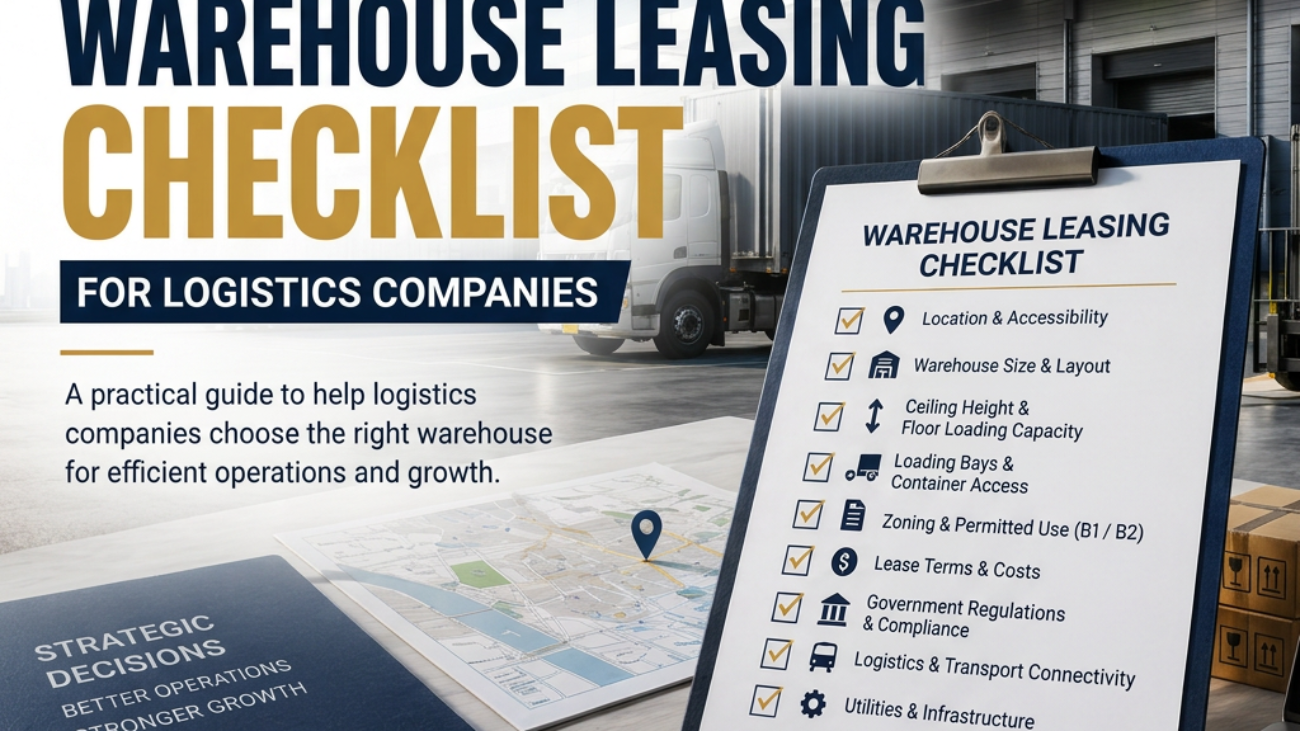
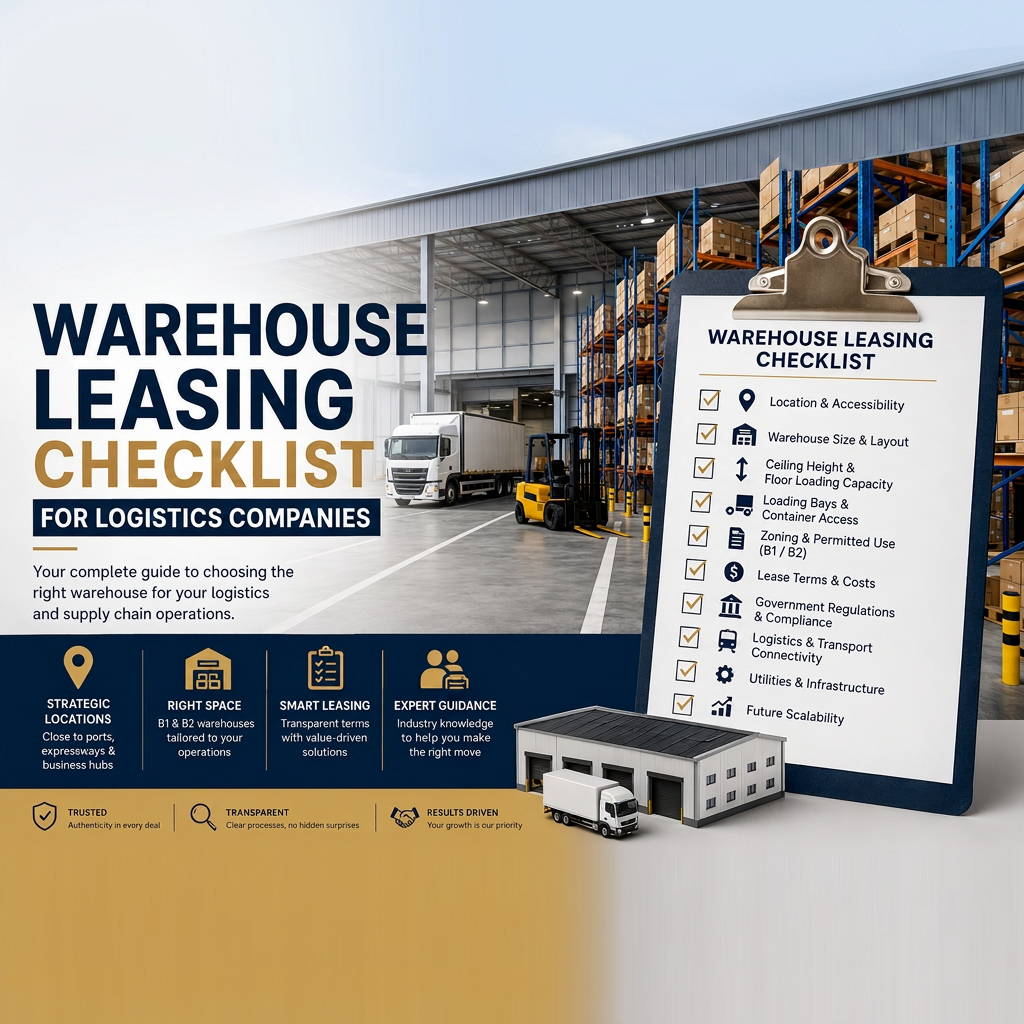
warehouse leasing checklist

Warehouse Leasing Checklist for Logistics Companies

Warehouse Leasing Checklist for Logistics Companies: What to Verify Before You Sign in Singapore

If you’re scaling a logistics operation in or into Singapore, the warehouse you choose will quietly determine your margins for the next three to six years. A cheap headline rent on a unit with no ramp access, a weak floor load rating, or a 45-minute detour from PSA or Changi Airfreight Centre can cost more in wasted trips than the rent itself. This is the warehouse leasing checklist we walk logistics clients through at SRG Real Estate before any offer to lease is signed — built for teams operating between India and Singapore, where cross-border 3PLs, freight forwarders, and distribution businesses are actively hunting for reliable B2 industrial space.

Singapore’s industrial market has now posted rental growth for over five years running. The JTC All Industrial Rental Index climbed 0.4% quarter-on-quarter in Q1 2026, and warehouse-specific rents rose again in Q2 2026, with overall industrial occupancy at 89.1%. Translation: good warehouse stock near the ports, PIE, and AYE is not sitting idle, and logistics tenants who move without a checklist tend to overpay or under-spec.

Quick Answer: The 12-Point Warehouse Leasing Checklist

  1. Zoning — B1 (light industrial) vs B2 (general industrial) suitability for your cargo
  2. Loading bay count, dock height, and truck turning radius
  3. Ceiling height and floor loading (kN/m²) for your racking system
  4. Proximity to ports (PSA Tuas, Jurong Port) and Changi Airfreight Centre
  5. Proximity to MRT for warehouse staff and last-mile riders
  6. JTC land lease vs private strata vs master-lease sub-tenancy
  7. Lease tenure, renewal option, and rent escalation clause
  8. All-in occupancy cost: rent + property tax + service charge + GST
  9. Fire safety, sprinkler (FM200/wet system), and SCDF compliance
  10. Racking system compatibility and floor flatness (FM2 standard)
  11. Power load (3-phase capacity) for cold chain or automation
  12. Sub-letting, assignment, and expansion/downsizing flexibility

Each item below explains why it matters and what actually to check — not just what to ask.

1. Confirm Zoning: B1 vs B2 Industrial Property Singapore

Before anything else, confirm whether the unit is zoned B1 (light industrial) or B2 (general industrial). A B2 industrial warehouse Singapore listing permits heavier, noisier, or higher-intensity logistics use — palletised storage, cross-docking, light assembly — while B1 space restricts certain activities and machinery. Freight forwarders and 3PLs handling general cargo almost always need B2 zoning; B1 units may look cheaper but can force you into a URA change-of-use application later, which costs time and sometimes isn’t approved at all.

2. Loading Bay, Dock Height, and Truck Access

This is the single most underrated line item on any warehouse rental checklist Singapore logistics operators use. Check:

  • Number of loading bays relative to your daily truck volume
  • Dock leveller height (standard container trucks vs smaller vans)
  • Turning radius for 40-ft trailers if you handle containerised freight
  • Whether the loading bay is covered (matters during Singapore’s rainy months)

A warehouse with excellent square footage but a single loading bay will bottleneck your operation the moment volumes scale.

3. Ceiling Height, Floor Load, and Racking System Compatibility

Your racking system determines your storage density, and your racking system depends entirely on ceiling clear height and floor load capacity (measured in kN/m²). Ramp-up B2 warehouses typically offer 6–12m clear height suited to selective or narrow-aisle racking; ground-floor conventional warehouses may cap out lower. Ask for the structural floor load rating in writing — not a verbal estimate — especially if you’re running high-bay racking or mezzanine storage.

4. Proximity to Ports and Air Cargo Hubs

For logistics warehouse Singapore searches specifically, location relative to PSA’s Tuas mega-port, Jurong Port, and Changi Airfreight Centre should shape your shortlist before price does. Every extra 10km of drayage between port and warehouse adds recurring trucking cost that compounds over a 3-year lease. This is why Tuas, Gul Circle, and the western industrial corridor remain the default first search for import/export-heavy logistics tenants.

5. Proximity to MRT

Warehouse operations still run on people — pickers, forklift operators, admin staff, last-mile riders. Space within 10–15 minutes of an MRT station has a measurably easier time hiring and retaining warehouse staff than sites reachable only by shuttle bus. Worth trading a small rent premium for, particularly outside peak logistics zones.

6. Understand Your Lease Structure: JTC vs Private Landlord

Two very different paths exist for a JTC warehouse lease in Singapore:

  • Direct JTC lease — you lease land or ready-built facilities straight from JTC Corporation, Singapore’s industrial landlord. JTC revised its rental rates for the second half of 2026, effective 1 July 2026, so always confirm you’re quoted the current rate card, not an outdated one.
  • Private landlord / master-lease sub-tenancy — most listed “warehouse for rent Singapore” units are actually private strata-titled space or sub-leased from a master tenant. These offer more flexible tenure (1–3 years vs JTC’s longer commitments), but rents are market-driven and can move faster with demand cycles.

Neither path is universally “better” — it depends on whether you need long-term security (JTC) or short-to-mid-term flexibility (private).

7. Lease Tenure, Renewal Terms, and Escalation Clauses

Standard private industrial leases in Singapore run 2–3 years with a renewal option; JTC land leases run far longer (often 30+30 years for land, shorter for ready-built facilities). Before signing, get clarity on:

  • Rent-free fitting-out period (typically 1–2 months)
  • Annual escalation percentage, if any
  • Renewal option terms and whether rent reverts to “prevailing market rate”
  • Reinstatement obligations at lease end (this can be a real cost — get a quote upfront)

8. Calculate the True All-In Occupancy Cost

The quoted psf rent is never the full number. Budget for:

  • Base rent — Singapore industrial/warehouse psf asking rates currently range roughly from S1.00toS3.50 per sq ft per month depending on location, specification, and building age, with high-spec ramp-up B2 space and cold-chain facilities sitting at the upper end.
  • Property tax on industrial property Singapore — non-owner-occupied industrial property is taxed at a flat 10% of Annual Value, payable to IRAS. If you’re subletting or your landlord passes this through, factor it into your effective occupancy cost.
  • Commercial lease stamp duty Singapore — tenancy stamp duty is charged at 0.4% of the total rent for leases of four years or less (or 0.4% of four times the average annual rent for longer leases), payable to IRAS before the lease is finalised.
  • GST on industrial property Singapore — GST at the prevailing standard rate of 9% applies to rent and service charges where the landlord is GST-registered.
  • Service charge — covers common area maintenance, security, and shared facilities; varies significantly by building.

Add these four together, and the “real” psf cost is often 15–25% higher than the headline asking rent.

9. Fire Safety and SCDF Compliance

Logistics warehouses storing flammable goods, F&B, or pharma stock need to confirm the unit’s fire safety classification matches your cargo type. Ask for the Fire Safety Certificate status, sprinkler system type, and whether SCDF approval is required for your specific storage use before you commit — retrofitting a sprinkler system after signing is expensive and slow.

10. Power Load and Utilities

Cold-chain, automated racking, and EV-charging fleets all draw significant power. Confirm the unit’s 3-phase electrical capacity in writing, not verbally, especially if you’re inheriting a fit-out from a previous tenant whose usage profile was different from yours.

11. Sub-Letting, Assignment, and Flexibility Clauses

Logistics demand is seasonal and contract-driven. Before signing, check whether the lease permits sub-letting or assignment if your space needs shrink mid-term, and whether the landlord offers a right of first refusal on adjacent units if you need to expand. This single clause has saved several of our clients from breaking a lease early.

12. Total Cost vs Total Fit: Don’t Optimise for Rent Alone

The lowest psf option is rarely the lowest total-cost option once drayage distance, staff turnover, and reinstatement costs are factored in. Run the full checklist above against two or three shortlisted units before deciding — not just the cheapest one.

Where to Look: Warehouse for Lease by Location

Warehouse for lease Tuas — Singapore’s primary western logistics and port-adjacent corridor, now anchoring PSA’s Tuas mega-port operations. Best fit for import/export-heavy 3PLs and freight forwarders who need short drayage distances and B2 zoning at scale.

Warehouse for lease Woodlands — Northern corridor with strong connectivity toward the Woodlands Checkpoint, useful for logistics companies running cross-border freight into Malaysia alongside domestic Singapore distribution.

Warehouse for lease Senoko — Established industrial estate in the north with a mix of B1 and B2 stock, popular with mid-sized logistics and light manufacturing tenants seeking value relative to central locations.

Warehouse for lease Gul Circle — Deep in the Jurong/Tuas industrial belt, close to Jurong Port and Gul Circle MRT — a strong shortlist candidate for heavy B2 general industrial and bulk storage warehouse requirements in Singapore.

Supply and Rent Trends Logistics Tenants Should Watch in 2026

A few data points worth knowing before you negotiate:

  • Industrial and warehouse rents have now risen for over 20 consecutive quarters. However, the pace of increase has been easing through 2026 — useful leverage when negotiating renewal terms rather than assuming rents will keep climbing at the same rate.
  • JTC expects roughly 400,000 sq m of new industrial space to be completed in the second half of 2026, with close to half of that being warehouse space — meaning more B2 warehouse-for-lease Singapore options should surface through late 2026 and into 2027, particularly benefiting tenants who can wait for new completions rather than needing space immediately.
  • High-specification, ramp-up, and cold-chain facilities remain the tightest segment even as aggregate supply grows, because suitability depends on ramp access, loading provision, and building spec — not just floor area.

If your lease renewal or search window has flexibility, timing your move around these completions can meaningfully improve your negotiating position.

Work With a Warehouse Property Agent Who Knows the Checklist

At SRG Real Estate, warehouse leasing Singapore searches are one of our most common briefs from logistics companies expanding between India and Singapore. As an SRG industrial property agent, we run every shortlisted unit through this exact checklist before it reaches a client — zoning, loading bay capacity, all-in cost, and lease flexibility — so you’re not discovering a floor-load problem after signing.

Whether you’re comparing B2 industrial warehouse Singapore options in Tuas, evaluating a JTC warehouse lease, or need a fast market read on warehouse space for logistics company use near the ports, our team can shortlist units and negotiate terms on your behalf.

Get in touch with SRG Real Estate for warehouse leasing support in Singapore: 🌐 srgrealestate.sg ⭐ View our Google reviews 🏢 UEN: S3515756L

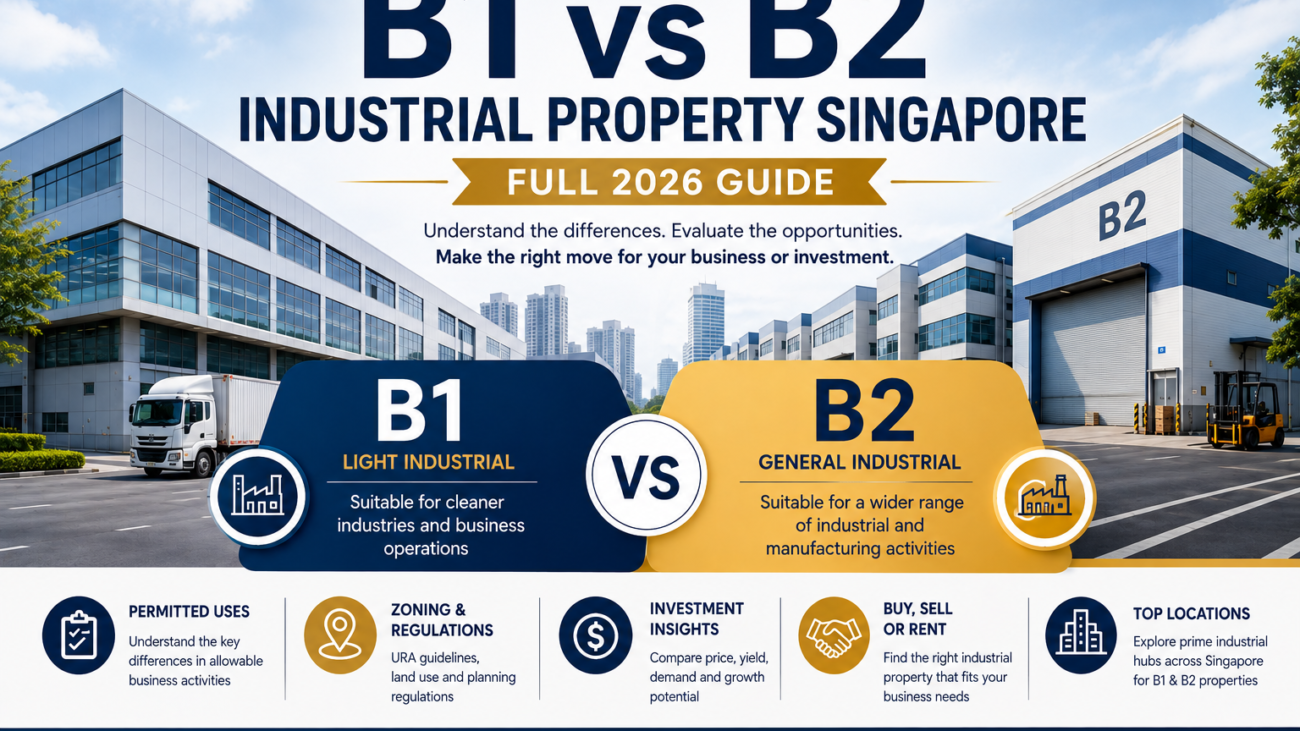
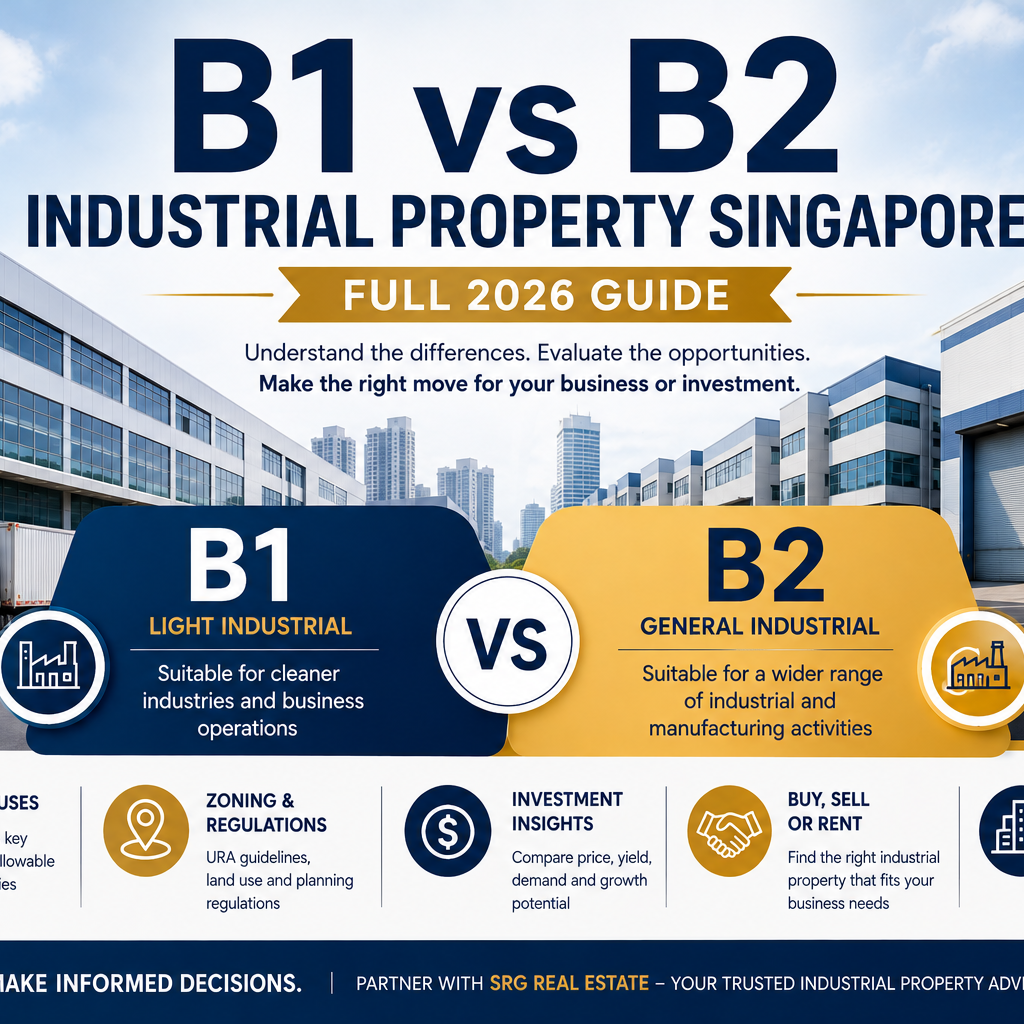
SRG Real Estate infographic comparing B1 and B2 industrial zoning in Singapore

Ultimate Guide to B1 vs B2 Industrial Property in Singapore 2026

Understanding B1 vs B2 Industrial Properties in Singapore

Additionally, if you’re looking at factories rather than homes, you will notice B1 vs B2 industrial properties in Singapore on listings.

However, explanations usually come late, after you make multiple viewings regarding B1 vs B2 industrial properties in Singapore.

Additionally, this gap in B1 vs B2 industrial properties in Singapore is what this guide is meant to close.

Whether you’re a manufacturer outgrowing your unit, an investor comparing yield across asset classes, or an Indian entrepreneur or NRI.

The B1 vs B2 industrial properties Singapore distinction isn’t a technicality.

Additionally, B1 vs B2 industrial properties Singapore determine what you’re allowed inside the four walls you pay for.

Get it wrong, and you could face a URA enforcement notice.

Moreover, a forced relocation, or a rejected Change of Use, could follow in B1 vs B2 industrial properties in Singapore.

At SRG Real Estate, this is one of the questions we field often from both local SMEs and overseas investors.

SRG Real Estate infographic comparing B1 and B2 industrial zoning in Singapore
B1 vs B2 Industrial Property Singapore: Full 2026 Guide

What Is B1 Industrial Property in Singapore?

B1 is short for “Business 1” — a URA Master Plan zoning classification reserved for clean, light, and non-pollutive industrial activity. Think electronics assembly, software and R&D operations, precision engineering, media production, packaging, and light warehousing. None of these generates the noise, smoke, odour, or vibration that would bother a neighbour, which is precisely why B1 industrial space in Singapore is allowed to sit close to residential and commercial districts

However, B1 vs B2 industrial properties in Singapore illustrate how zoning choices can shape nearby development and ensure compatibility. As a result, these uses are designed to minimise emissions and disruption to nearby areas, aligning with urban planning goals. Consequently, B1 space remains suitable for locations near residential and commercial districts.

The National Environment Agency backs this up with a 50-metre nuisance buffer requirement between a B1 development and its surroundings — a much lighter restriction than what applies to heavier industry. That’s also why B1 buildings have started looking less like factories and more like offices. Many newer B1 factory developments in Singapore feature glass facades, lift lobbies, and business-park-style common areas, even though the internal floor loading and power specs are still built for genuine industrial use.

A useful way to think about B1: if your business could plausibly operate in a building where people also live within a few hundred meters, it’s probably a B1 fit.

What Is B2 Industrial Property in Singapore?

B2, or “Business 2,” is the zoning for general and heavy industrial use

In Singapore, B1 vs B2 industrial properties illustrate contrasting use profiles.

This covers heavier manufacturing, vehicle servicing and workshops, and chemical or biotech processing.

Additionally, B1 vs B2 industrial properties in Singapore it includes operations involving significant noise. It also involves emissions or heavy vehicle traffic.

B2 industrial estates are deliberately kept away from residential areas, concentrated instead in estates like Jurong, Tuas, Woodlands, Senoko, Kranji, and Buroh.

B2 space typically comes with larger floor plates, higher floor loading, and more generous loading-bay and heavy-vehicle access — the physical infrastructure heavier operations actually need. Rents per square foot tend to run lower than B1, partly because B2 estates sit further from MRT lines and residential catchments, and partly because the tenant pool is more specialised.

B1 vs B2 Industrial Property Singapore: Key Differences at a Glance

FactorB1 (Light Industrial)B2 (General/Heavy Industrial)
Permitted useClean, light industry — electronics, R&D, packaging, light warehousingHeavier manufacturing, workshops, chemical/biotech, logistics
Environmental impactMinimal — no significant noise, smoke, odourHigher — noise, emissions, heavy traffic possible
Nuisance buffer50m NEA buffer from residential areasLarger buffer; deliberately segregated from housing
Typical estatesUbi, Kaki Bukit, Tai Seng, KallangJurong, Tuas, Woodlands, Senoko, Kranji
MRT accessGenerally goodVariable, often car/truck-dependent
Rental rateHigher psfLower psf
Tenant profileTech, R&D, media, precision engineering, showroomsManufacturing, logistics, vehicle servicing, process industries
Capital appreciation (5-yr trend)Stronger in MRT-linked estatesMore moderate, higher entry-to-exit spread

Neither zone is inherently “better” — the right one depends entirely on what your business does or what tenant profile you’re underwriting as an investor.

The URA 60:40 Rule Explained.

Regardless of whether you’re in a B1 or B2 building, URA’s industrial property zoning framework applies a 60:40 usage rule to nearly every unit. At least 60% of the gross floor area must go toward the approved core industrial activity — manufacturing, warehousing, R&D, or whatever the anchor use is. The remaining 40% can be ancillary space: offices, a showroom, a staff canteen, meeting rooms.

This is one of the most common compliance traps for both new tenants and unfamiliar investors. Fit out too much of the unit as office space, and you’re technically in breach — which can trigger enforcement action or the need for a Change of Use application, along with the fees and delays that come with it. If you’re buying B1 or B2 industrial property for sale in Singapore with a specific tenant already lined up, it’s worth checking their intended floor plan against the 60:40 ratio before the deal is signed, not after.

JTC vs Private Industrial Property: What Buyers Need to Know

A large share of Singapore’s industrial land is leased out by JTC Corporation, the government’s master industrial landlord, typically on 20- to 30-year terms (with some private-developer leasehold stock running to 60 years). JTC-leased units carry conditions that private strata industrial property doesn’t:

  • Assignment approval — selling or subletting a JTC unit generally needs JTC’s sign-off, and the incoming buyer must qualify as a genuine industrialist with an approved use, not a passive investor.
  • Occupation requirements — many JTC allocations require the buyer to actually operate a qualifying business from the unit for a minimum period, screening out pure yield-chasers.
  • Since September 2017, resale of strata industrial units acquired from a developer is restricted to end-users only for the first three years, a rule the Ministry of Trade and Industry introduced specifically to curb speculative flipping.

By contrast, private strata industrial developments — more common in estates like Ubi, Kaki Bukit, Tai Seng, and Paya Lebar — can usually be bought by individual investors without demonstrating an active industrial business, financed through standard commercial loans, and sublet freely. If your primary goal is rental yield rather than owner-occupation, private strata B1 or B2 stock is usually the more accessible route.

In 2026, JTC also widened its lease renewal framework: eligible tenants can now engage JTC up to 10 years before lease expiry (up from 6), and a Flexible Lease Extension Initiative lets qualifying 20-year lessees extend by up to two 5-year tranches. Worth factoring in if you’re evaluating a JTC-leased asset with a shorter remaining tenure.

Where to Find B1 and B2 Industrial Property: Central Singapore & Key Estates

Location-wise, B1 industrial property in Central Singapore clusters around Ubi, Kaki Bukit, Kallang, and Tai Seng — mature estates well served by the MRT and close enough to town to appeal to tech, media, and design tenants who still want an industrial rent instead of a CBD office rent. B2 industrial property in Central Singapore is far rarer, since heavier industry has historically been pushed to the west and north — Jurong Industrial Estate, Tuas, and Woodlands remain the core B2 clusters.

This geographic split matters for anyone comparing industrial property in Singapore as an investment: B1 units in inner, MRT-linked estates have shown stronger five-year capital appreciation, driven by land scarcity and the gradual upgrading of older industrial stock. B2 assets in the outer west have generally delivered higher gross rental yields at a lower entry price, appealing to investors underwriting cash flow over capital growth.

Can B1 Industrial Property Be Used for Manufacturing in Singapore?.

Yes — but only for manufacturing that falls within the “clean and light” definition. Additionally, in B1 vs B2 industrial properties in Singapore, electronics assembly and precision engineering are common in B1 buildings. What B1 does not permit is any process generating significant noise, smoke, odour, or vibration. Welding-heavy fabrication, large-scale chemical processing, or anything requiring heavy machinery with a large footprint typically needs a B2-zoned unit. If you’re unsure which side of the line your process falls on, obtain confirmation from URA before you commit. Therefore, this helps avoid NEA complaints later.

B1 vs B2 Industrial Property for Investment: Which Offers Better Returns?

There’s no universal answer — it comes down to what you’re optimising for.

  • B1 in MRT-accessible estates tends to command a premium purchase price but attracts a broader, higher-quality tenant pool (tech firms, R&D outfits, corporates wanting an “office-like” industrial address), which supports both occupancy and capital appreciation over time.
  • B2 in outer estates typically offers a lower entry price and a higher headline rental yield, but the tenant base is more specialised and more exposed to manufacturing-sector cycles.

Industrial property in Singapore tends to outyield residential. Moreover, gross yields are in the mid-single digits, higher than private residential. Additionally, unlike residential property, industrial property carries no ABSD for any buyer. This holds for citizens, PRs, and foreigners. For B1 vs B2 industrial properties in Singapore, this difference draws Indian investors and NRIs. No ABSD wall and no Residential Property Act restrictions. Investors gain full eligibility to purchase strata industrial or commercial units without special approval.

Buying or Renting B1/B2 Industrial Property: Costs, Stamp Duty & Foreign Investor Eligibility

A few finance and government-facing details worth knowing before you transact:

  • Buyer’s Stamp Duty (BSD) applies to industrial property purchases, same as any other property type, but ABSD does not — a meaningful cost saving compared to residential.
  • GST may apply if the seller is GST-registered, calculated on the purchase price — a cost that catches first-time commercial and industrial buyers off guard.
  • Seller’s Stamp Duty (SSD) restrictions can apply within the first three years for certain strata industrial resales bought from a developer, even though industrial property is otherwise SSD-light compared to residential.
  • Financing for industrial property typically comes with a lower loan-to-value ratio than residential, so plan for more equity upfront.
  • Foreign eligibility: foreigners, including Indian nationals and NRIs, face no additional restrictions on buying industrial property in Singapore beyond the same JTC assignment/occupation conditions that apply to any buyer of JTC-leased stock. Private strata B1/B2 units are generally the more straightforward entry point for a foreign investor who isn’t planning to operate the business personally.

None of this is tax or legal advice — always verify current BSD/GST rates and JTC eligibility conditions with IRAS, JTC, and your own lawyer or tax advisor before transacting, since these figures are revised periodically.

Working With an Industrial Property Agent in Singapore

Because B1 and B2 zoning, the 60:40 rule, and JTC assignment conditions all interact with each other, most buyers and tenants don’t shop for industrial property the way they’d shop for a condo. A specialist industrial property agent or industrial real estate consultant in Singapore will typically flag zoning fit, check the intended-use compliance before you fall in love with a unit, and — for JTC-leased stock — help pre-screen eligibility before you waste time on an application that was never going to be approved.

At SRG Real Estate, our industrial desk works across both B1 and B2 stock island-wide, including Central Singapore’s B1-heavy estates and the western B2 clusters, for local businesses, investors, and overseas buyers — including a growing number of Indian and NRI clients evaluating Singapore industrial property as part of a broader Southeast Asia allocation.

The Bottom Line

B1 and B2 aren’t just zoning codes — they define who your neighbours can be, what your business is legally allowed to do inside the unit, how the space will be priced, and who’s likely to want it back from you when you sell. Getting the classification right before you sign anything saves you from a URA enforcement letter down the line, and getting the investment case right — B1’s appreciation story versus B2’s yield story — depends on what you’re actually trying to build.

If you’re comparing B1 vs B2 industrial property for your own operations or as an investment, SRG Real Estate’s industrial team can walk you through current listings, JTC eligibility, and zoning fit across Singapore’s industrial estates. Reach out for a no-obligation consultation.