
retail shop location in Singapore

How to Choose the Right Retail Shop Location in Singapore

How to Choose the Right Retail Shop Location in Singapore (2026 Guide)

Choosing where to plant your shop is one of the few decisions in retail that you can’t easily undo. You can change your pricing, refresh your signage, or pivot your product range overnight — but a five-year lease on the wrong street corner will quietly drain your business for years. If you’re searching for retail space in Singapore or trying to figure out how to choose a retail shop location, this guide walks through the real factors — footfall, rent benchmarks, taxes, and district-by-district trade-offs — that separate a shop that thrives from one that just survives.
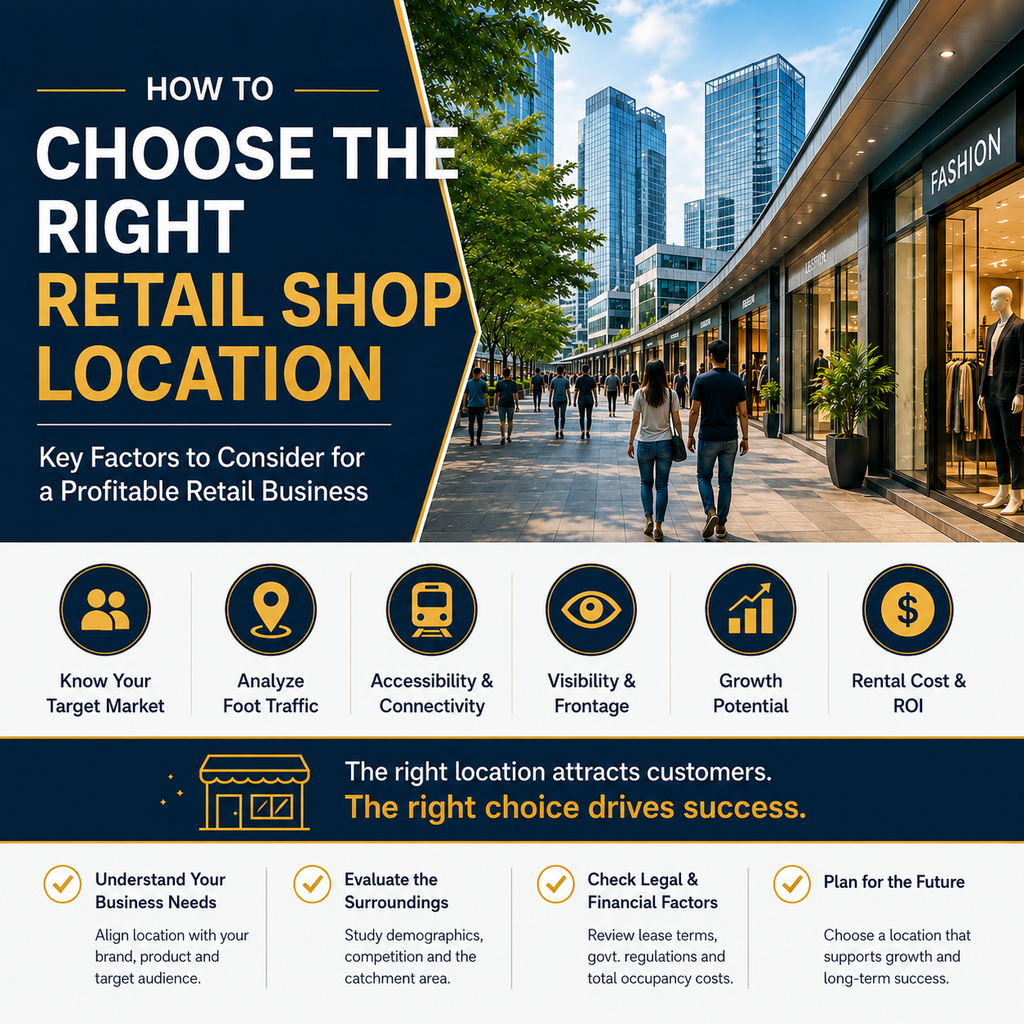
This guide is built for two audiences: entrepreneurs and franchise operators based in Singapore, and Indian investors or retail brands looking at commercial property in Singapore as an entry point into Southeast Asia. Wherever the rules differ for foreign buyers, we’ve flagged it.

Why Location Still Decides Retail Success in 2026

Online shopping hasn’t erased the value of a physical shop — it has raised the bar for what a physical shop needs to do. A location today has to earn its rent through visibility, convenience, and experience, not just proximity to shoppers. Landlords across Singapore have responded by leaning harder into experiential and service-led tenants — beauty, wellness, fitness, F&B, and enrichment brands — while mid-market fashion and low-differentiation retailers face more pressure to justify their space. If your shop can’t articulate why it needs to be seen and visited in person, the wrong location will expose that gap fast.

That’s the lens to bring into every one of the factors below.

Factors to Consider When Choosing a Retail Shop Location

1. Pedestrian Traffic and Footfall Quality

Raw footfall numbers are only half the story — the more useful question is whether the people walking past are your people. A bubble tea kiosk and a bridal boutique can sit on the same street and need completely different traffic patterns: one wants volume and impulse buyers, the other wants intentional, planned visits. Before committing to a unit, spend time physically observing the street at different hours — weekday lunch crowd, evening commute, weekend leisure traffic — rather than relying on a landlord’s footfall claims alone.

2. Population Density and Catchment Profile

A shop’s real catchment is usually a 10–15 minute walk or a short ride, not the whole district. Look at who actually lives and works within that radius: household income, age profile, family size, and whether the area skews residential, office, or transient (tourists, students). Suburban malls in Singapore have benefited precisely because they sit inside dense residential catchments where shoppers no longer feel the need to travel to Orchard Road for everyday retail — a trend that has kept suburban rents climbing steadily even as some central precincts see slower growth.

3. MRT Proximity and Connectivity

MRT proximity remains one of the strongest predictors of sustained footfall in Singapore retail. Units directly linked to or within a two-minute walk of an MRT exit command a premium, but they earn it back through consistent daily traffic that doesn’t depend on weather, events, or seasonality. If your budget can’t stretch to a station-linked unit, the next best option is a location on a direct bus route or a short, safe, well-lit walk from the nearest station — shoppers will forgive a five-minute walk; they won’t forgive a confusing one.

4. Ground-Floor Visibility and Unit Positioning

A ground-floor unit with street frontage will almost always outperform an upper-floor or basement unit for a walk-in retail concept, because it removes the single biggest friction point in retail: getting someone through the door. If a ground-floor unit is out of budget, prioritise clear sightlines from the main entrance or escalator bank instead — a second-floor unit that shoppers see the moment they enter the mall behaves very differently from one tucked around a corner.

5. Competitor and Complementary Tenant Mix

Being near competitors isn’t automatically bad — clusters of similar shops (a “beauty street” or “F&B row”) can pull in shoppers specifically looking to compare and browse. What matters is whether you’re the strongest option in that mix or the weakest. Equally important are complementary tenants nearby: a children’s enrichment centre benefits from being near a supermarket or pediatric clinic; a formal wear shop benefits from proximity to event venues or photography studios.

6. Rental Cost Versus Realistic Revenue Potential

This is where how to calculate retail shop location potential becomes a genuine numbers exercise, not a gut feeling. As of Q1 2026, Cushman & Wakefield recorded prime Orchard retail rents at roughly S$36.50 psf per month, suburban prime rents at around S$33.30 psf per month, and other city-area prime rents near S$21 psf per month — with all three segments still edging upward quarter-on-quarter. Knight Frank’s separate basket put average Orchard gross rent closer to S$31.70 psf per month, underlining that “prime” figures vary by methodology and exact unit.

A simple sanity check before signing: estimate your realistic monthly footfall, apply a conservative conversion rate and average transaction value, and see whether that revenue comfortably covers rent plus a healthy operating margin — not just breaks even. Many first-time retail operators anchor their decision on rent per square foot alone and skip this step entirely.

7. Lease Terms, Renewal Options, and Fit-Out Costs

Beyond headline rent, scrutinise the lease’s escalation clauses, renewal terms, reinstatement obligations, and any restrictions on signage or hours. A slightly cheaper unit with a rigid three-year lease and no renewal option can end up costing more in relocation and fit-out costs than a marginally pricier unit with flexibility built in.

Best Areas to Open a Retail Shop in Singapore

Orchard retail shop Singapore — Singapore’s prime shopping belt commands the highest rents in the country and remains the strongest address for luxury, beauty, and flagship-format brands seeking maximum brand visibility and tourist footfall. Recent leasing activity here has skewed toward established luxury names, which tells you the segment this precinct now rewards best.

Bugis retail shop Singapore — The Bugis and City Hall micro-market has posted some of the strongest rental growth in Singapore over the past year, benefiting from a mix of tourist, office worker, and youth-oriented footfall. It suits fashion, lifestyle, and F&B concepts that want central-area visibility without paying full Orchard rents.

Jurong retail shop Singapore — As a designated regional centre with ongoing residential and commercial growth, Jurong offers suburban rent levels with a genuinely large and growing local catchment. It’s a strong fit for daily-needs retail, F&B, and family-oriented service brands that depend on repeat local visits rather than tourist spend.

East Coast retail space — This corridor combines established residential density with a lifestyle and leisure identity, making it attractive for F&B, fitness, and speciality retail that benefits from a relaxed, community-driven shopper mindset rather than a transactional, mall-hopping one.

The right answer isn’t “which of these is best” — it’s which one matches your product, price point, and target customer’s shopping behaviour.

Regulatory and Financial Considerations for Commercial Property in Singapore

If you’re buying rather than renting, the tax structure for commercial property differs meaningfully from residential property — and understanding this is especially important for retail shop for rent Singapore searchers who may later consider buying, and for foreign investors comparing markets.

  • Buyer’s Stamp Duty (BSD) on commercial property: Commercial and industrial property follows its own progressive schedule — 1% on the first S$180,000, 2% on the next S$180,000, 3% on the next S$640,000, 4% on the next S$500,000, and 5% on the remainder up to S$1 billion. This is a materially different (and in most practical price bands, gentler) schedule than the residential one, which climbs to 6% above S$3 million.
  • Additional Buyer’s Stamp Duty (ABSD): This is the single biggest reason commercial property attracts strong foreign interest — ABSD applies only to residential property in Singapore. A foreign investor buying a retail shop or commercial unit pays the same BSD as a Singapore citizen, with no ABSD layered on top, unlike a residential purchase where a foreign buyer currently faces a steep additional duty.
  • GST on commercial property: Singapore’s GST rate stands at 9% as of 2026, with no change confirmed in Budget 2026. GST applies to the sale and lease of commercial and industrial property — including retail units and shophouses — when the seller or landlord is GST-registered. If you’re GST-registered yourself, this amount is generally recoverable as input tax; if not, it becomes a real additional cost that should be built into your budget upfront.
  • Seller’s Stamp Duty (SSD): Pure commercial retail units are not subject to SSD regardless of holding period — a meaningful advantage over residential property, where SSD can apply for up to four years after purchase.

Regulatory disclaimer: The above figures reflect Singapore stamp duty, GST, and property regulations as verified in August 2026. Tax rates and thresholds are subject to change in future Budget announcements — always confirm current rates with IRAS or a qualified property consultant before transacting.

Renting vs. Buying: A Quick Framework

If you’re testing a concept, expanding cautiously, or watching cash flow closely, a retail unit for rent in Singapore or shophouse for rent in Singapore arrangement keeps capital free and lets you exit or relocate if the location underperforms If you have a proven, established concept and want to lock in occupancy cost against rising rents — or you’re a foreign investor drawn by the absence of ABSD on commercial assets — buying a commercial property for sale Singapore may make more long-term sense. Either path benefits from working with a commercial real estate agent in Singapore who can benchmark the unit against genuine comparable transactions, not just asking rents.

Why Work With a Local Retail Property Specialist

Choosing between a commercial shop in Singapore on a quiet side street and a commercial retail space unit in Singapore inside a high-traffic mall isn’t a decision you should make from listing photos alone. A retail property agent in Singapore who actively works Orchard, Bugis, Jurong, and East Coast deals can tell you which units have genuine footfall versus which ones photograph well but underperform, what a landlord will actually negotiate on rent-free fit-out periods, and which upcoming supply might affect your rent trajectory over the lease term.

As a Singapore retail property specialist, SRG Real Estate works with retail operators and investors — including businesses expanding from India into the Singapore market — to match the right unit to the right concept, not just the right budget. From SRG Real Estate retail properties and SRG Real Estate commercial property listings to end-to-end guidance as your SRG retail property consultant, we help you evaluate footfall, lease terms, and total occupancy cost before you sign anything. Explore current SRG Real Estate shop space listings or speak with our team to shortlist locations that fit your business, not just your budget.
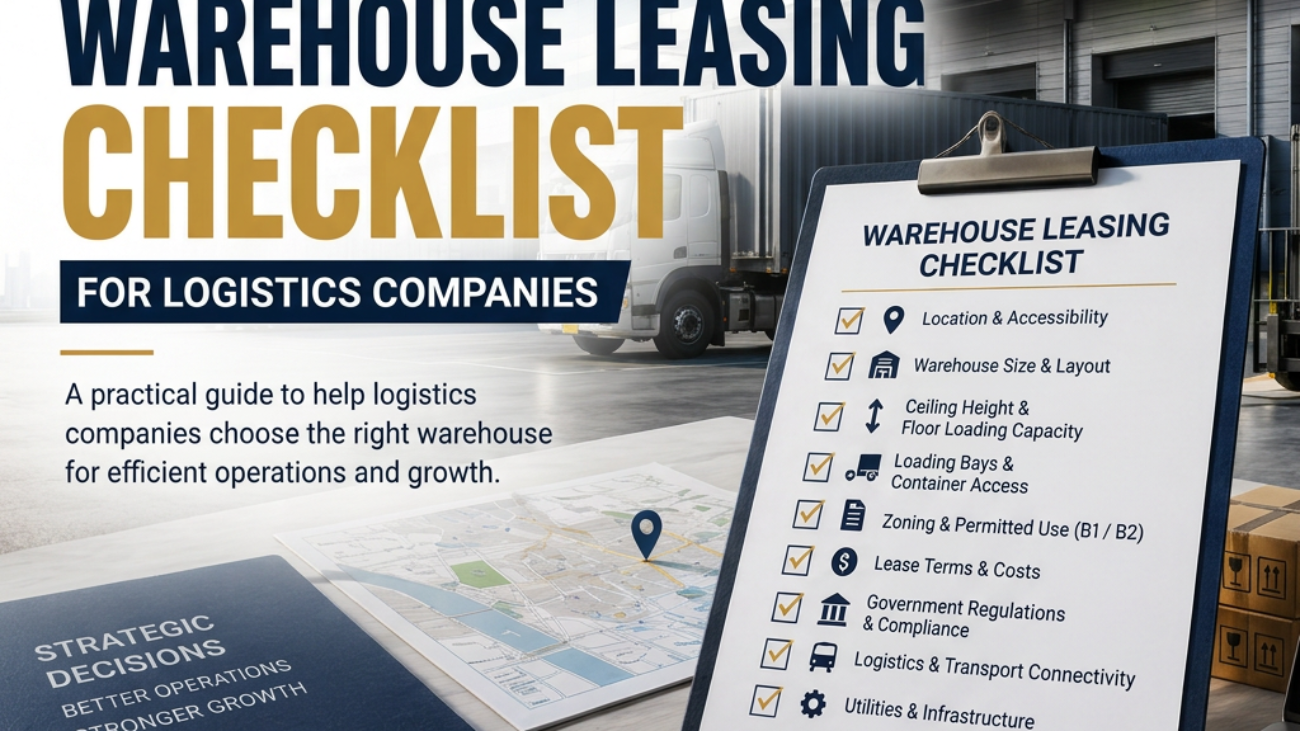
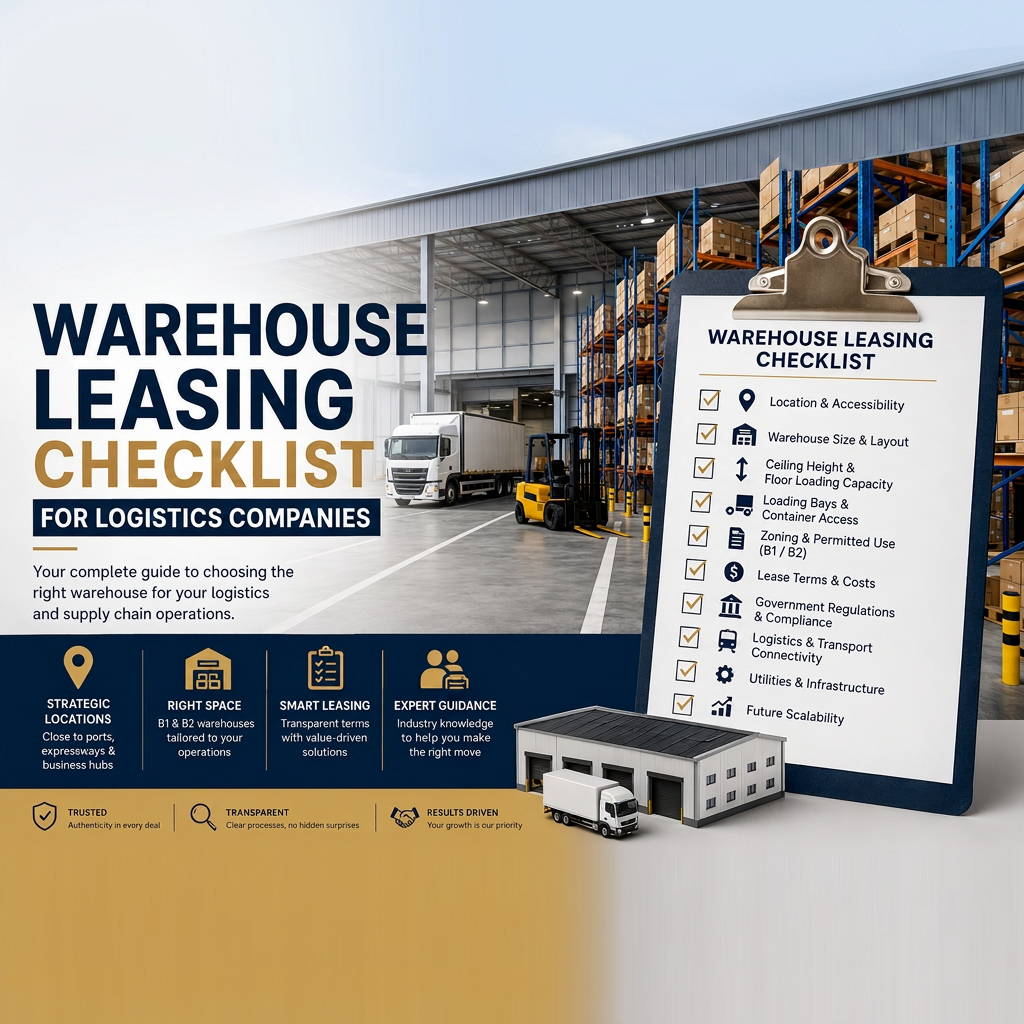
warehouse leasing checklist

Warehouse Leasing Checklist for Logistics Companies

Warehouse Leasing Checklist for Logistics Companies: What to Verify Before You Sign in Singapore

If you’re scaling a logistics operation in or into Singapore, the warehouse you choose will quietly determine your margins for the next three to six years. A cheap headline rent on a unit with no ramp access, a weak floor load rating, or a 45-minute detour from PSA or Changi Airfreight Centre can cost more in wasted trips than the rent itself. This is the warehouse leasing checklist we walk logistics clients through at SRG Real Estate before any offer to lease is signed — built for teams operating between India and Singapore, where cross-border 3PLs, freight forwarders, and distribution businesses are actively hunting for reliable B2 industrial space.

Singapore’s industrial market has now posted rental growth for over five years running. The JTC All Industrial Rental Index climbed 0.4% quarter-on-quarter in Q1 2026, and warehouse-specific rents rose again in Q2 2026, with overall industrial occupancy at 89.1%. Translation: good warehouse stock near the ports, PIE, and AYE is not sitting idle, and logistics tenants who move without a checklist tend to overpay or under-spec.

Quick Answer: The 12-Point Warehouse Leasing Checklist

  1. Zoning — B1 (light industrial) vs B2 (general industrial) suitability for your cargo
  2. Loading bay count, dock height, and truck turning radius
  3. Ceiling height and floor loading (kN/m²) for your racking system
  4. Proximity to ports (PSA Tuas, Jurong Port) and Changi Airfreight Centre
  5. Proximity to MRT for warehouse staff and last-mile riders
  6. JTC land lease vs private strata vs master-lease sub-tenancy
  7. Lease tenure, renewal option, and rent escalation clause
  8. All-in occupancy cost: rent + property tax + service charge + GST
  9. Fire safety, sprinkler (FM200/wet system), and SCDF compliance
  10. Racking system compatibility and floor flatness (FM2 standard)
  11. Power load (3-phase capacity) for cold chain or automation
  12. Sub-letting, assignment, and expansion/downsizing flexibility

Each item below explains why it matters and what actually to check — not just what to ask.

1. Confirm Zoning: B1 vs B2 Industrial Property Singapore

Before anything else, confirm whether the unit is zoned B1 (light industrial) or B2 (general industrial). A B2 industrial warehouse Singapore listing permits heavier, noisier, or higher-intensity logistics use — palletised storage, cross-docking, light assembly — while B1 space restricts certain activities and machinery. Freight forwarders and 3PLs handling general cargo almost always need B2 zoning; B1 units may look cheaper but can force you into a URA change-of-use application later, which costs time and sometimes isn’t approved at all.

2. Loading Bay, Dock Height, and Truck Access

This is the single most underrated line item on any warehouse rental checklist Singapore logistics operators use. Check:

  • Number of loading bays relative to your daily truck volume
  • Dock leveller height (standard container trucks vs smaller vans)
  • Turning radius for 40-ft trailers if you handle containerised freight
  • Whether the loading bay is covered (matters during Singapore’s rainy months)

A warehouse with excellent square footage but a single loading bay will bottleneck your operation the moment volumes scale.

3. Ceiling Height, Floor Load, and Racking System Compatibility

Your racking system determines your storage density, and your racking system depends entirely on ceiling clear height and floor load capacity (measured in kN/m²). Ramp-up B2 warehouses typically offer 6–12m clear height suited to selective or narrow-aisle racking; ground-floor conventional warehouses may cap out lower. Ask for the structural floor load rating in writing — not a verbal estimate — especially if you’re running high-bay racking or mezzanine storage.

4. Proximity to Ports and Air Cargo Hubs

For logistics warehouse Singapore searches specifically, location relative to PSA’s Tuas mega-port, Jurong Port, and Changi Airfreight Centre should shape your shortlist before price does. Every extra 10km of drayage between port and warehouse adds recurring trucking cost that compounds over a 3-year lease. This is why Tuas, Gul Circle, and the western industrial corridor remain the default first search for import/export-heavy logistics tenants.

5. Proximity to MRT

Warehouse operations still run on people — pickers, forklift operators, admin staff, last-mile riders. Space within 10–15 minutes of an MRT station has a measurably easier time hiring and retaining warehouse staff than sites reachable only by shuttle bus. Worth trading a small rent premium for, particularly outside peak logistics zones.

6. Understand Your Lease Structure: JTC vs Private Landlord

Two very different paths exist for a JTC warehouse lease in Singapore:

  • Direct JTC lease — you lease land or ready-built facilities straight from JTC Corporation, Singapore’s industrial landlord. JTC revised its rental rates for the second half of 2026, effective 1 July 2026, so always confirm you’re quoted the current rate card, not an outdated one.
  • Private landlord / master-lease sub-tenancy — most listed “warehouse for rent Singapore” units are actually private strata-titled space or sub-leased from a master tenant. These offer more flexible tenure (1–3 years vs JTC’s longer commitments), but rents are market-driven and can move faster with demand cycles.

Neither path is universally “better” — it depends on whether you need long-term security (JTC) or short-to-mid-term flexibility (private).

7. Lease Tenure, Renewal Terms, and Escalation Clauses

Standard private industrial leases in Singapore run 2–3 years with a renewal option; JTC land leases run far longer (often 30+30 years for land, shorter for ready-built facilities). Before signing, get clarity on:

  • Rent-free fitting-out period (typically 1–2 months)
  • Annual escalation percentage, if any
  • Renewal option terms and whether rent reverts to “prevailing market rate”
  • Reinstatement obligations at lease end (this can be a real cost — get a quote upfront)

8. Calculate the True All-In Occupancy Cost

The quoted psf rent is never the full number. Budget for:

  • Base rent — Singapore industrial/warehouse psf asking rates currently range roughly from S1.00toS3.50 per sq ft per month depending on location, specification, and building age, with high-spec ramp-up B2 space and cold-chain facilities sitting at the upper end.
  • Property tax on industrial property Singapore — non-owner-occupied industrial property is taxed at a flat 10% of Annual Value, payable to IRAS. If you’re subletting or your landlord passes this through, factor it into your effective occupancy cost.
  • Commercial lease stamp duty Singapore — tenancy stamp duty is charged at 0.4% of the total rent for leases of four years or less (or 0.4% of four times the average annual rent for longer leases), payable to IRAS before the lease is finalised.
  • GST on industrial property Singapore — GST at the prevailing standard rate of 9% applies to rent and service charges where the landlord is GST-registered.
  • Service charge — covers common area maintenance, security, and shared facilities; varies significantly by building.

Add these four together, and the “real” psf cost is often 15–25% higher than the headline asking rent.

9. Fire Safety and SCDF Compliance

Logistics warehouses storing flammable goods, F&B, or pharma stock need to confirm the unit’s fire safety classification matches your cargo type. Ask for the Fire Safety Certificate status, sprinkler system type, and whether SCDF approval is required for your specific storage use before you commit — retrofitting a sprinkler system after signing is expensive and slow.

10. Power Load and Utilities

Cold-chain, automated racking, and EV-charging fleets all draw significant power. Confirm the unit’s 3-phase electrical capacity in writing, not verbally, especially if you’re inheriting a fit-out from a previous tenant whose usage profile was different from yours.

11. Sub-Letting, Assignment, and Flexibility Clauses

Logistics demand is seasonal and contract-driven. Before signing, check whether the lease permits sub-letting or assignment if your space needs shrink mid-term, and whether the landlord offers a right of first refusal on adjacent units if you need to expand. This single clause has saved several of our clients from breaking a lease early.

12. Total Cost vs Total Fit: Don’t Optimise for Rent Alone

The lowest psf option is rarely the lowest total-cost option once drayage distance, staff turnover, and reinstatement costs are factored in. Run the full checklist above against two or three shortlisted units before deciding — not just the cheapest one.

Where to Look: Warehouse for Lease by Location

Warehouse for lease Tuas — Singapore’s primary western logistics and port-adjacent corridor, now anchoring PSA’s Tuas mega-port operations. Best fit for import/export-heavy 3PLs and freight forwarders who need short drayage distances and B2 zoning at scale.

Warehouse for lease Woodlands — Northern corridor with strong connectivity toward the Woodlands Checkpoint, useful for logistics companies running cross-border freight into Malaysia alongside domestic Singapore distribution.

Warehouse for lease Senoko — Established industrial estate in the north with a mix of B1 and B2 stock, popular with mid-sized logistics and light manufacturing tenants seeking value relative to central locations.

Warehouse for lease Gul Circle — Deep in the Jurong/Tuas industrial belt, close to Jurong Port and Gul Circle MRT — a strong shortlist candidate for heavy B2 general industrial and bulk storage warehouse requirements in Singapore.

Supply and Rent Trends Logistics Tenants Should Watch in 2026

A few data points worth knowing before you negotiate:

  • Industrial and warehouse rents have now risen for over 20 consecutive quarters. However, the pace of increase has been easing through 2026 — useful leverage when negotiating renewal terms rather than assuming rents will keep climbing at the same rate.
  • JTC expects roughly 400,000 sq m of new industrial space to be completed in the second half of 2026, with close to half of that being warehouse space — meaning more B2 warehouse-for-lease Singapore options should surface through late 2026 and into 2027, particularly benefiting tenants who can wait for new completions rather than needing space immediately.
  • High-specification, ramp-up, and cold-chain facilities remain the tightest segment even as aggregate supply grows, because suitability depends on ramp access, loading provision, and building spec — not just floor area.

If your lease renewal or search window has flexibility, timing your move around these completions can meaningfully improve your negotiating position.

Work With a Warehouse Property Agent Who Knows the Checklist

At SRG Real Estate, warehouse leasing Singapore searches are one of our most common briefs from logistics companies expanding between India and Singapore. As an SRG industrial property agent, we run every shortlisted unit through this exact checklist before it reaches a client — zoning, loading bay capacity, all-in cost, and lease flexibility — so you’re not discovering a floor-load problem after signing.

Whether you’re comparing B2 industrial warehouse Singapore options in Tuas, evaluating a JTC warehouse lease, or need a fast market read on warehouse space for logistics company use near the ports, our team can shortlist units and negotiate terms on your behalf.

Get in touch with SRG Real Estate for warehouse leasing support in Singapore: 🌐 srgrealestate.sg ⭐ View our Google reviews 🏢 UEN: S3515756L

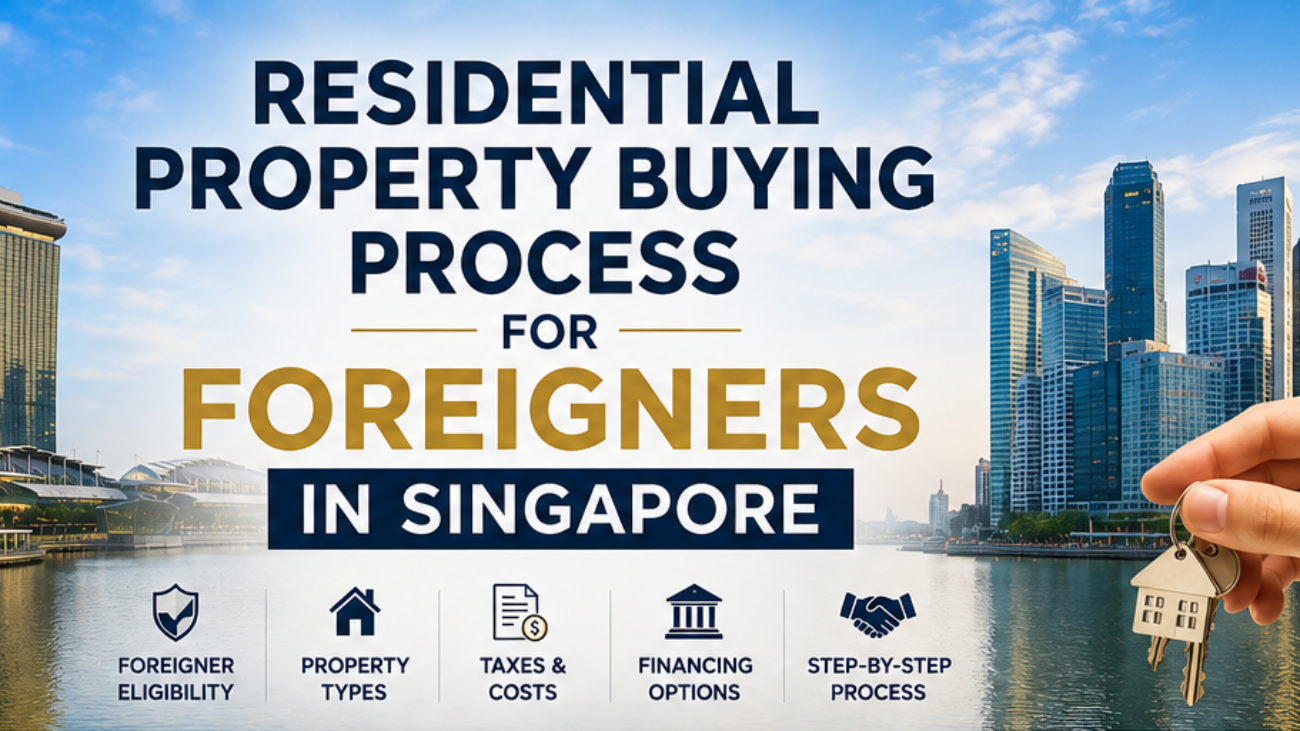
residential property buying process for foreigners in Singapore

Residential Property Buying Process for Foreigners in Singapore

If you’ve been searching for “residential property buying process for foreigners in Singapore,” the short answer is yes. More foreigners are doing it yearly, attracted by Singapore’s stability, strong currency, and world-class infrastructure.

This guide outlines the residential property buying process for foreigners in Singapore. It covers what you can buy, how much it costs, and how the transaction unfolds.

It will also help you avoid surprises three weeks into a deal.

We work with buyers from India, the Gulf, China, and beyond monthly at SRG Real Estate. The questions are almost always the same: What am I allowed to own? What will I actually pay in stamp duty? Can I get a loan? Here’s the complete residential property buying process for foreigners in Singapore, based on the current 2026 rules.

What Can Foreigners Actually Buy?

Confusion often begins here.

Singapore’s Residential Property Act splits housing into two broad buckets.

Which bucket a property falls into determines whether you need government approval to buy it.

Freely purchasable, no approval needed:

  • Private condominiums and apartments (any district, any developer)
  • Strata-titled landed houses inside approved condo developments
  • Executive Condominiums (ECs) once they pass their 10-year Minimum Occupation Period and are fully privatized

Restricted, requires Land Dealings Approval Unit (LDAU) clearance:

  • Landed homes — bungalows, semi-detached houses, terrace houses, Good Class Bungalows — anywhere outside Sentosa Cove
  • Vacant residential land

Completely off-limits to non-citizens and non-PRs:

  • HDB flats (new or resale)

Sentosa Cove is the one well-known exception where foreigners can buy a landed home without the usual LDAU hurdle. Owner-occupation conditions apply. For the vast majority of overseas buyers, the practical answer is simple. The residential property buying process for foreigners in Singapore often centers on buying a condo. Over 95% of foreign residential transactions in Singapore fall into the private condominium and apartment category. It has zero approval friction, so you can walk into a purchase the same week you find the right unit.

The Real Cost: ABSD, BSD, and What They Mean for You

Buyers in Singapore pay Buyer’s Stamp Duty (BSD), a progressive tax.

It runs from 1% on the first S$180,000 up to 6% on amounts above S$3 million.

For a S$2 million condo, BSD is about S$69,600, payable within 14 days of exercising your Option to Purchase.

Then comes the number that changes the entire equation for overseas buyers: Additional Buyer’s Stamp Duty for foreigners in Singapore currently sits at a flat 60%, applied to any residential purchase regardless of whether it’s your first property or your fifth. This rate has held since April 2023, and Budget 2026 didn’t touch it. On a S$1.8 million Marina Bay condo, that’s roughly S$1.08 million in ABSD alone, on top of BSD.

There’s one notable carve-out: nationals of the United States, Iceland, Liechtenstein, Norway, and Switzerland are treated the same as Singapore Citizens for ABSD purposes under their countries’ Free Trade Agreements with Singapore, meaning 0% on a first property. Everyone else — including Indian, Malaysian, Chinese, and Gulf nationals — pays the full 60% rate. If you’re weighing Singapore against other Southeast Asian markets, this is the single biggest cost variable to model before you fall in love with a floor plan.

Can Foreigners Get a Property Loan in Singapore?

Yes. Singapore banks — DBS, OCBC, and UOB, and several foreign banks — do lend to non-residents. The terms are tighter than what locals get.

  • Loan-to-Value (LTV): up to 75% on a first private residential property, provided the loan tenure stays within 30 years and ends before you turn 65
  • Total Debt Servicing Ratio (TDSR): all monthly debt commitments, including the new mortgage, can’t exceed 55% of gross monthly income, stress-tested at roughly 4%
  • CPF: off the table — non-PR foreigners fund everything in cash
  • Documentation: passport, employment pass or equivalent, 3–6 months of payslips, tax assessments, and often a Singapore-based relationship manager

Getting an In-Principle Approval (IPA) from a bank before you start viewing units is worth the extra few days — it tells you your real budget and makes your offer more credible when you do put in an Option to Purchase.

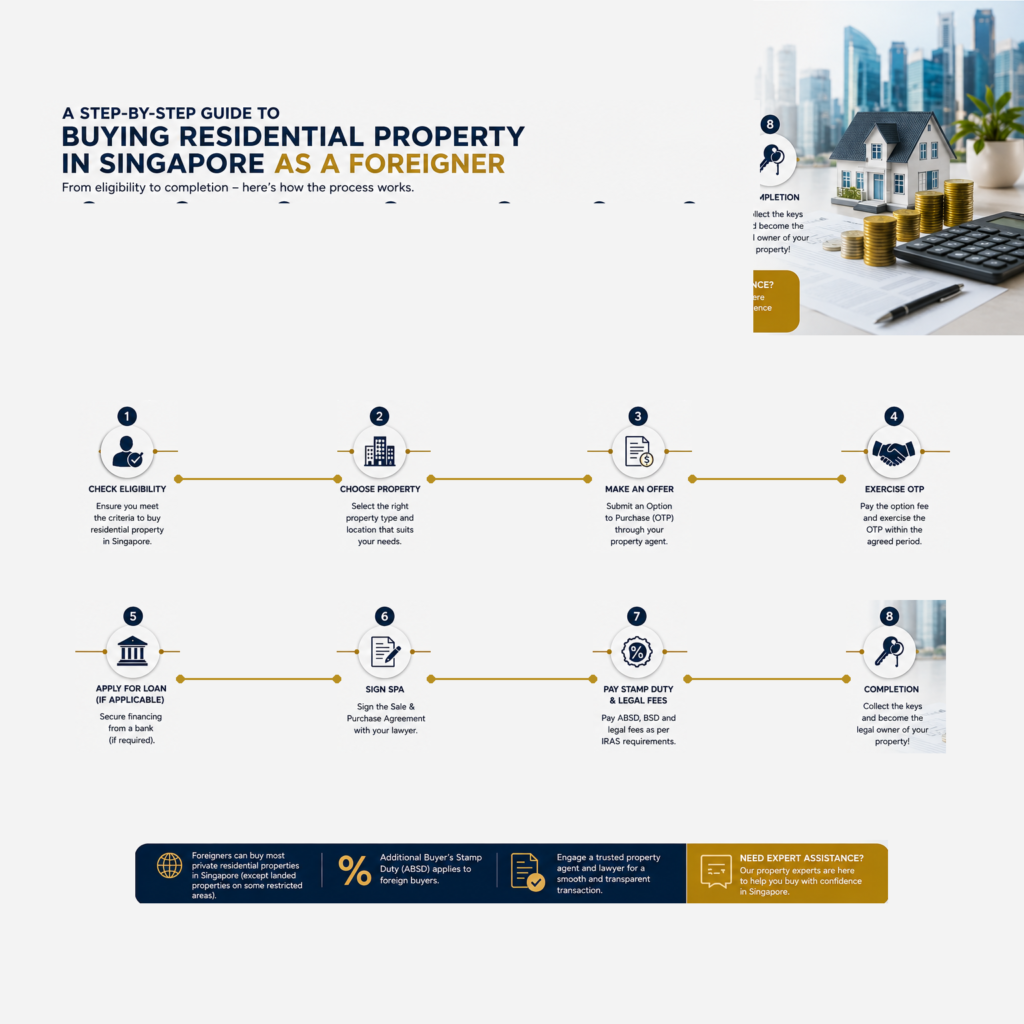
The Step-by-Step Buying Process

  1. Get pre-approved. Secure In-Principle Approval from a bank so you know your borrowing limit before you shop.
  2. Search and shortlist. Work with a licensed property agent in Singapore who understands foreign-buyer eligibility — this rules out restricted landed stock immediately and saves you weeks.
  3. View and negotiate. Once you find the unit, agree on price and terms with the seller or developer.
  4. Sign the Option to Purchase (OTP). You pay an option fee (commonly 1% of the price) for an exclusive window — typically 14 days for resale — to decide.
  5. Exercise the OTP. Pay a further deposit (bringing the total to around 5%), which converts the option into a binding contract.
  6. Pay stamp duties. Your conveyancing lawyer e-stamps the transaction with IRAS and settles BSD and ABSD, due within 14 days of exercise.
  7. Finalize your mortgage. The bank arranges valuation and prepares the loan for disbursement.
  8. Complete the purchase. For a resale unit, completion typically lands 8–12 weeks after exercising the OTP; new launches under progressive payment run on a longer schedule tied to construction stages.
  9. Collect your keys. Your solicitor registers the transfer with the Singapore Land Registry, and the property is officially yours.

Where Foreign Buyers Are Looking

In Singapore, foreign demand concentrates in prime districts such as District 9, 10, and 11.

These areas include Orchard, Holland, Bukit Timah, and Novena.

Moreover, it is increasingly directed at Marina Bay and the Downtown Core.

Additionally, new-launch condos and waterfront apartments offer lifestyle appeal and rental depth.

When weighing a new launch against a resale unit, remember that new launches feature fresh fittings and progressive payment terms.

Resale provides a faster path to keys and a track record of actual rental yields to study.

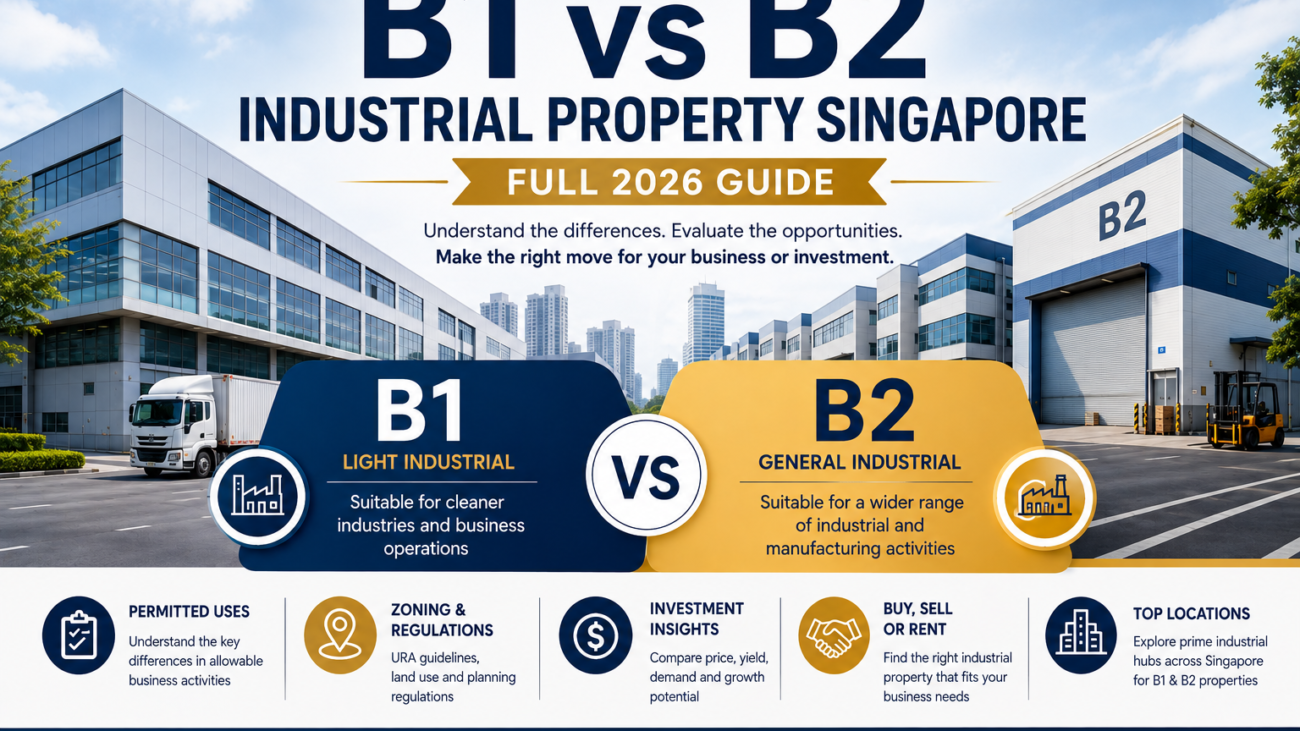
SRG Real Estate infographic comparing B1 and B2 industrial zoning in Singapore

Ultimate Guide to B1 vs B2 Industrial Property in Singapore 2026

Understanding B1 vs B2 Industrial Properties in Singapore

Additionally, if you’re looking at factories rather than homes, you will notice B1 vs B2 industrial properties in Singapore on listings.

However, explanations usually come late, after you make multiple viewings regarding B1 vs B2 industrial properties in Singapore.

Additionally, this gap in B1 vs B2 industrial properties in Singapore is what this guide is meant to close.

Whether you’re a manufacturer outgrowing your unit, an investor comparing yield across asset classes, or an Indian entrepreneur or NRI.

The B1 vs B2 industrial properties Singapore distinction isn’t a technicality.

Additionally, B1 vs B2 industrial properties Singapore determine what you’re allowed inside the four walls you pay for.

Get it wrong, and you could face a URA enforcement notice.

Moreover, a forced relocation, or a rejected Change of Use, could follow in B1 vs B2 industrial properties in Singapore.

At SRG Real Estate, this is one of the questions we field often from both local SMEs and overseas investors.

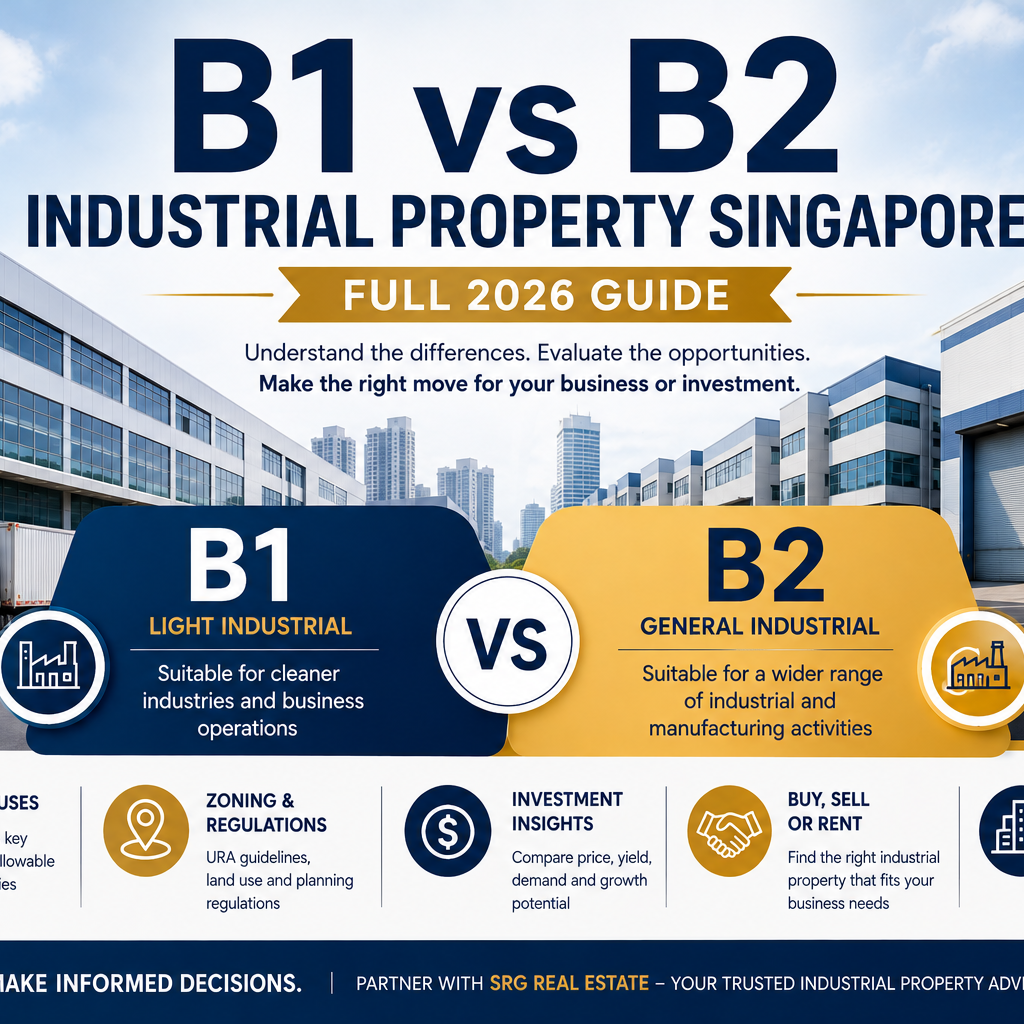
SRG Real Estate infographic comparing B1 and B2 industrial zoning in Singapore
B1 vs B2 Industrial Property Singapore: Full 2026 Guide

What Is B1 Industrial Property in Singapore?

B1 is short for “Business 1” — a URA Master Plan zoning classification reserved for clean, light, and non-pollutive industrial activity. Think electronics assembly, software and R&D operations, precision engineering, media production, packaging, and light warehousing. None of these generates the noise, smoke, odour, or vibration that would bother a neighbour, which is precisely why B1 industrial space in Singapore is allowed to sit close to residential and commercial districts

However, B1 vs B2 industrial properties in Singapore illustrate how zoning choices can shape nearby development and ensure compatibility. As a result, these uses are designed to minimise emissions and disruption to nearby areas, aligning with urban planning goals. Consequently, B1 space remains suitable for locations near residential and commercial districts.

The National Environment Agency backs this up with a 50-metre nuisance buffer requirement between a B1 development and its surroundings — a much lighter restriction than what applies to heavier industry. That’s also why B1 buildings have started looking less like factories and more like offices. Many newer B1 factory developments in Singapore feature glass facades, lift lobbies, and business-park-style common areas, even though the internal floor loading and power specs are still built for genuine industrial use.

A useful way to think about B1: if your business could plausibly operate in a building where people also live within a few hundred meters, it’s probably a B1 fit.

What Is B2 Industrial Property in Singapore?

B2, or “Business 2,” is the zoning for general and heavy industrial use

In Singapore, B1 vs B2 industrial properties illustrate contrasting use profiles.

This covers heavier manufacturing, vehicle servicing and workshops, and chemical or biotech processing.

Additionally, B1 vs B2 industrial properties in Singapore it includes operations involving significant noise. It also involves emissions or heavy vehicle traffic.

B2 industrial estates are deliberately kept away from residential areas, concentrated instead in estates like Jurong, Tuas, Woodlands, Senoko, Kranji, and Buroh.

B2 space typically comes with larger floor plates, higher floor loading, and more generous loading-bay and heavy-vehicle access — the physical infrastructure heavier operations actually need. Rents per square foot tend to run lower than B1, partly because B2 estates sit further from MRT lines and residential catchments, and partly because the tenant pool is more specialised.

B1 vs B2 Industrial Property Singapore: Key Differences at a Glance

FactorB1 (Light Industrial)B2 (General/Heavy Industrial)
Permitted useClean, light industry — electronics, R&D, packaging, light warehousingHeavier manufacturing, workshops, chemical/biotech, logistics
Environmental impactMinimal — no significant noise, smoke, odourHigher — noise, emissions, heavy traffic possible
Nuisance buffer50m NEA buffer from residential areasLarger buffer; deliberately segregated from housing
Typical estatesUbi, Kaki Bukit, Tai Seng, KallangJurong, Tuas, Woodlands, Senoko, Kranji
MRT accessGenerally goodVariable, often car/truck-dependent
Rental rateHigher psfLower psf
Tenant profileTech, R&D, media, precision engineering, showroomsManufacturing, logistics, vehicle servicing, process industries
Capital appreciation (5-yr trend)Stronger in MRT-linked estatesMore moderate, higher entry-to-exit spread

Neither zone is inherently “better” — the right one depends entirely on what your business does or what tenant profile you’re underwriting as an investor.

The URA 60:40 Rule Explained.

Regardless of whether you’re in a B1 or B2 building, URA’s industrial property zoning framework applies a 60:40 usage rule to nearly every unit. At least 60% of the gross floor area must go toward the approved core industrial activity — manufacturing, warehousing, R&D, or whatever the anchor use is. The remaining 40% can be ancillary space: offices, a showroom, a staff canteen, meeting rooms.

This is one of the most common compliance traps for both new tenants and unfamiliar investors. Fit out too much of the unit as office space, and you’re technically in breach — which can trigger enforcement action or the need for a Change of Use application, along with the fees and delays that come with it. If you’re buying B1 or B2 industrial property for sale in Singapore with a specific tenant already lined up, it’s worth checking their intended floor plan against the 60:40 ratio before the deal is signed, not after.

JTC vs Private Industrial Property: What Buyers Need to Know

A large share of Singapore’s industrial land is leased out by JTC Corporation, the government’s master industrial landlord, typically on 20- to 30-year terms (with some private-developer leasehold stock running to 60 years). JTC-leased units carry conditions that private strata industrial property doesn’t:

  • Assignment approval — selling or subletting a JTC unit generally needs JTC’s sign-off, and the incoming buyer must qualify as a genuine industrialist with an approved use, not a passive investor.
  • Occupation requirements — many JTC allocations require the buyer to actually operate a qualifying business from the unit for a minimum period, screening out pure yield-chasers.
  • Since September 2017, resale of strata industrial units acquired from a developer is restricted to end-users only for the first three years, a rule the Ministry of Trade and Industry introduced specifically to curb speculative flipping.

By contrast, private strata industrial developments — more common in estates like Ubi, Kaki Bukit, Tai Seng, and Paya Lebar — can usually be bought by individual investors without demonstrating an active industrial business, financed through standard commercial loans, and sublet freely. If your primary goal is rental yield rather than owner-occupation, private strata B1 or B2 stock is usually the more accessible route.

In 2026, JTC also widened its lease renewal framework: eligible tenants can now engage JTC up to 10 years before lease expiry (up from 6), and a Flexible Lease Extension Initiative lets qualifying 20-year lessees extend by up to two 5-year tranches. Worth factoring in if you’re evaluating a JTC-leased asset with a shorter remaining tenure.

Where to Find B1 and B2 Industrial Property: Central Singapore & Key Estates

Location-wise, B1 industrial property in Central Singapore clusters around Ubi, Kaki Bukit, Kallang, and Tai Seng — mature estates well served by the MRT and close enough to town to appeal to tech, media, and design tenants who still want an industrial rent instead of a CBD office rent. B2 industrial property in Central Singapore is far rarer, since heavier industry has historically been pushed to the west and north — Jurong Industrial Estate, Tuas, and Woodlands remain the core B2 clusters.

This geographic split matters for anyone comparing industrial property in Singapore as an investment: B1 units in inner, MRT-linked estates have shown stronger five-year capital appreciation, driven by land scarcity and the gradual upgrading of older industrial stock. B2 assets in the outer west have generally delivered higher gross rental yields at a lower entry price, appealing to investors underwriting cash flow over capital growth.

Can B1 Industrial Property Be Used for Manufacturing in Singapore?.

Yes — but only for manufacturing that falls within the “clean and light” definition. Additionally, in B1 vs B2 industrial properties in Singapore, electronics assembly and precision engineering are common in B1 buildings. What B1 does not permit is any process generating significant noise, smoke, odour, or vibration. Welding-heavy fabrication, large-scale chemical processing, or anything requiring heavy machinery with a large footprint typically needs a B2-zoned unit. If you’re unsure which side of the line your process falls on, obtain confirmation from URA before you commit. Therefore, this helps avoid NEA complaints later.

B1 vs B2 Industrial Property for Investment: Which Offers Better Returns?

There’s no universal answer — it comes down to what you’re optimising for.

  • B1 in MRT-accessible estates tends to command a premium purchase price but attracts a broader, higher-quality tenant pool (tech firms, R&D outfits, corporates wanting an “office-like” industrial address), which supports both occupancy and capital appreciation over time.
  • B2 in outer estates typically offers a lower entry price and a higher headline rental yield, but the tenant base is more specialised and more exposed to manufacturing-sector cycles.

Industrial property in Singapore tends to outyield residential. Moreover, gross yields are in the mid-single digits, higher than private residential. Additionally, unlike residential property, industrial property carries no ABSD for any buyer. This holds for citizens, PRs, and foreigners. For B1 vs B2 industrial properties in Singapore, this difference draws Indian investors and NRIs. No ABSD wall and no Residential Property Act restrictions. Investors gain full eligibility to purchase strata industrial or commercial units without special approval.

Buying or Renting B1/B2 Industrial Property: Costs, Stamp Duty & Foreign Investor Eligibility

A few finance and government-facing details worth knowing before you transact:

  • Buyer’s Stamp Duty (BSD) applies to industrial property purchases, same as any other property type, but ABSD does not — a meaningful cost saving compared to residential.
  • GST may apply if the seller is GST-registered, calculated on the purchase price — a cost that catches first-time commercial and industrial buyers off guard.
  • Seller’s Stamp Duty (SSD) restrictions can apply within the first three years for certain strata industrial resales bought from a developer, even though industrial property is otherwise SSD-light compared to residential.
  • Financing for industrial property typically comes with a lower loan-to-value ratio than residential, so plan for more equity upfront.
  • Foreign eligibility: foreigners, including Indian nationals and NRIs, face no additional restrictions on buying industrial property in Singapore beyond the same JTC assignment/occupation conditions that apply to any buyer of JTC-leased stock. Private strata B1/B2 units are generally the more straightforward entry point for a foreign investor who isn’t planning to operate the business personally.

None of this is tax or legal advice — always verify current BSD/GST rates and JTC eligibility conditions with IRAS, JTC, and your own lawyer or tax advisor before transacting, since these figures are revised periodically.

Working With an Industrial Property Agent in Singapore

Because B1 and B2 zoning, the 60:40 rule, and JTC assignment conditions all interact with each other, most buyers and tenants don’t shop for industrial property the way they’d shop for a condo. A specialist industrial property agent or industrial real estate consultant in Singapore will typically flag zoning fit, check the intended-use compliance before you fall in love with a unit, and — for JTC-leased stock — help pre-screen eligibility before you waste time on an application that was never going to be approved.

At SRG Real Estate, our industrial desk works across both B1 and B2 stock island-wide, including Central Singapore’s B1-heavy estates and the western B2 clusters, for local businesses, investors, and overseas buyers — including a growing number of Indian and NRI clients evaluating Singapore industrial property as part of a broader Southeast Asia allocation.

The Bottom Line

B1 and B2 aren’t just zoning codes — they define who your neighbours can be, what your business is legally allowed to do inside the unit, how the space will be priced, and who’s likely to want it back from you when you sell. Getting the classification right before you sign anything saves you from a URA enforcement letter down the line, and getting the investment case right — B1’s appreciation story versus B2’s yield story — depends on what you’re actually trying to build.

If you’re comparing B1 vs B2 industrial property for your own operations or as an investment, SRG Real Estate’s industrial team can walk you through current listings, JTC eligibility, and zoning fit across Singapore’s industrial estates. Reach out for a no-obligation consultation.