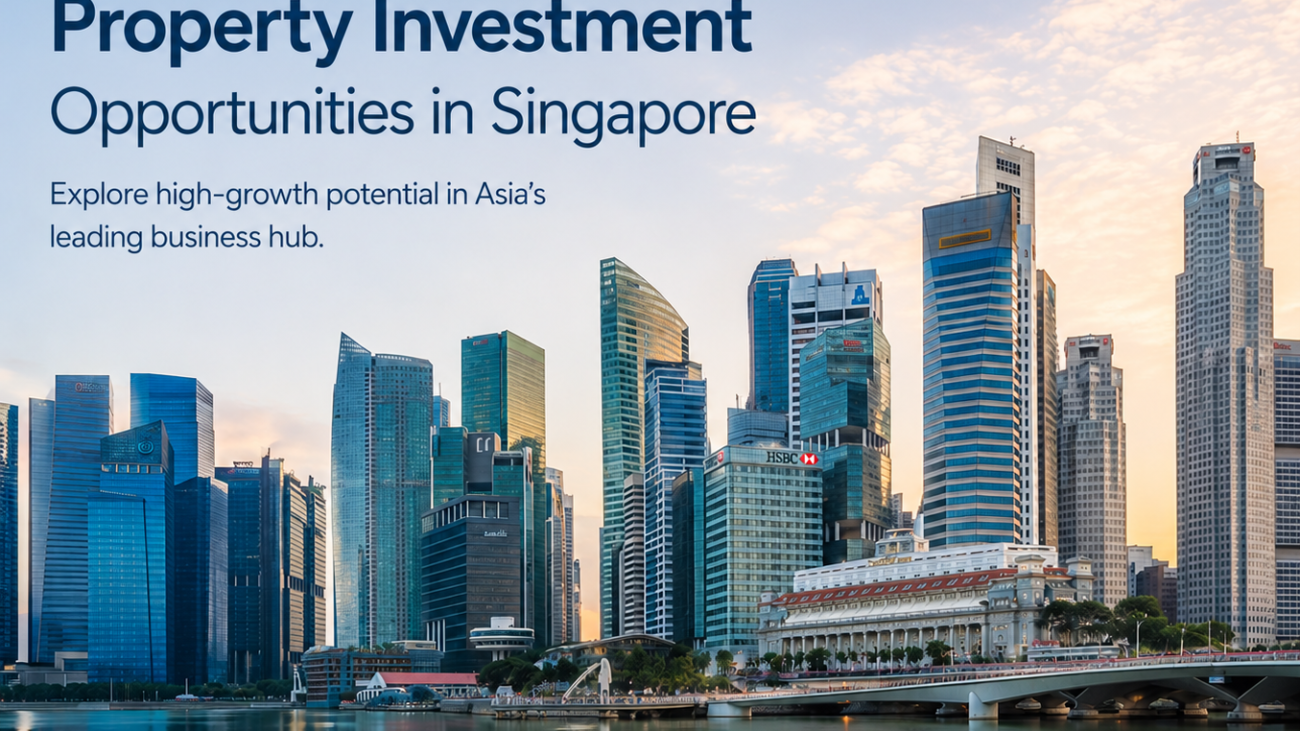

office space for lease Singapore

Office Space Leasing Guide Singapore

Office Space Leasing Guide for SMEs & Startups in Singapore

The office space for lease in the Singapore market is in its sixth straight year of rent growth, and that single fact changes how SMEs and startups should approach leasing in 2026. Singapore’s CBD Grade A office market has entered its sixth year of rent growth, the longest upward cycle on record, with gross effective rents rising to SGD 12.19 per square foot per month in Q2 2026. CBRE data separately puts core CBD Grade A rents at S$12.50 per square foot per month in Q2 2026, the sixth consecutive quarter of growth, with vacancy falling to 5.6%, the lowest in nine quarters.

For an SME or an early-stage startup, that’s not just a statistic — it’s the difference between signing a lease that fits your runway and locking yourself into rent escalations you didn’t budget for. This guide is a practical walk-through of how office leasing actually works in Singapore in 2026: what things cost by district, what the law requires, what to check before you sign, and how to avoid the mistakes that trip up first-time tenants.
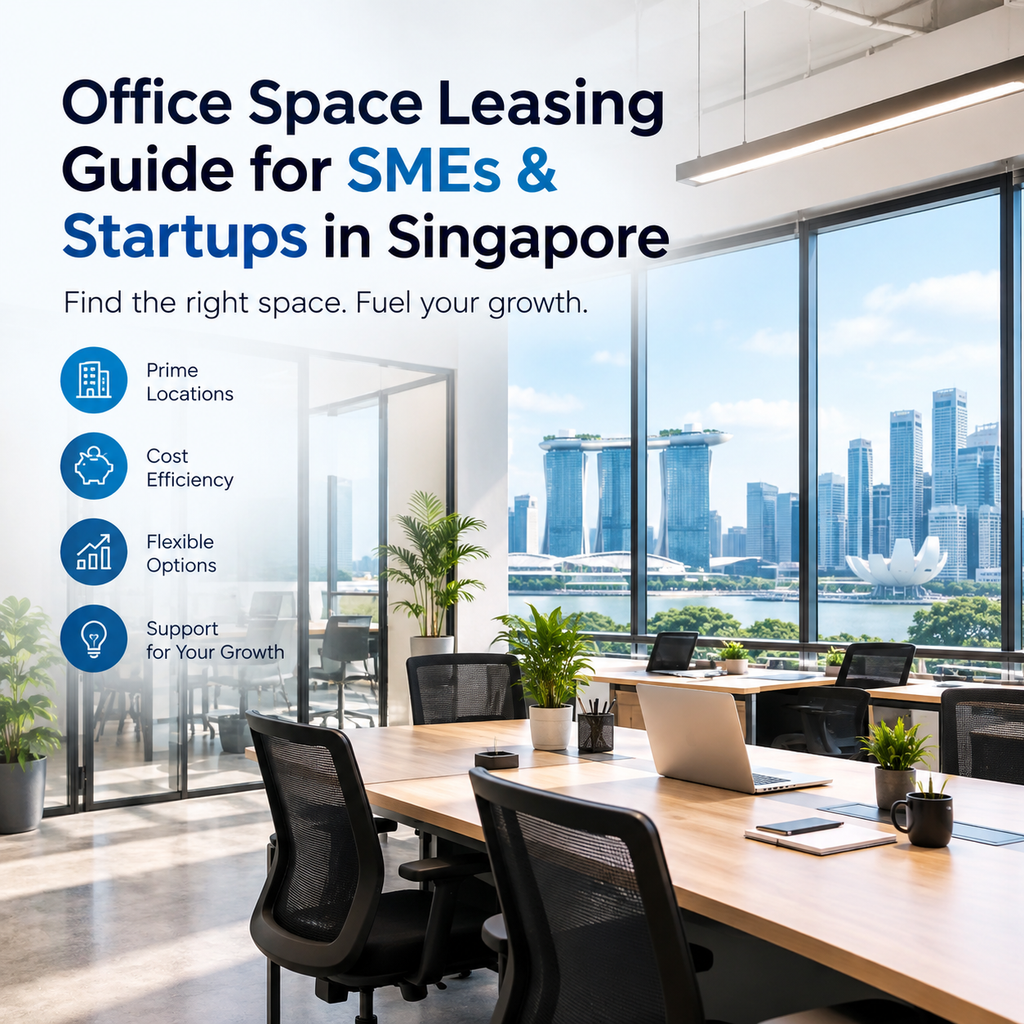
Whether you’re relocating a growing team, opening your first Singapore office as a foreign entrepreneur, or shifting from a home office to a registered commercial address, the framework below applies. And if you’d rather skip the research and go straight to viewing shortlisted spaces, that’s exactly what a commercial property agent Singapore businesses trust — like SRG Real Estate — is for.


1. Why Timing Matters More Than Usual in 2026

Three data points define the current market, and all three favor acting decisively rather than waiting for a “better deal” that historically hasn’t materialized:

  • Rents have risen for six consecutive quarters. Grade A CBD office rents rose 2.8% quarter-on-quarter to a record high in Q2 2026, the strongest quarterly growth since 2018, and increased 4.5% year-on-year — the largest annual increase since 2019.
  • Supply is thin and staying thin. Shaw Tower is the only major Grade A completion in 2026, Newport Tower is the sole non-strata development completing in 2027, and the next meaningful wave of supply — from The Sky-waters, The Clifford, One Commerce Centre and Union Square Central — isn’t expected until 2028.
  • Forecasts point in the same direction. Colliers expects 2–4% further growth, Savills projects around 2%, and CBRE has suggested 4–7% growth for CBD buildings through the rest of 2026.

The practical implication: SMEs negotiating renewals or new leases this year have less landlord flexibility than they did in 2022–2023. That makes the difference between an informed tenant and an uninformed one worth real money — which is the entire purpose of this guide.


2. Singapore Office Rental Rates by District (2026)

Office rental in Singapore is quoted per square foot per month ($ psf pm), and the spread between districts is wide enough that location strategy is really a budget strategy in disguise.

CBD Office Space Singapore (Raffles Place, Marina Bay, Shenton Way, Tanjong Pagar): Core CBD Grade A rental rates in 2026 range from roughly SGD 10–16 psf monthly. Raffles Place, Shenton Way and Robinson Road command SGD 12–16 psf for premium buildings, Marina Bay Financial Centre achieves SGD 11–14 psf, and the Tanjong Pagar micro-district — increasingly popular with tech and fin-tech tenants — ranges SGD 9–13 psf. Tanjong Pagar has become the preferred location for technology companies, fin-tech firms and businesses seeking modern building stock at a discount to Raffles Place.

One-North Office Rental (Business Park / Science Park zoning): One-North sits outside the CBD but competes on prestige. Listed asking rents in 2026 for buildings such as Nexus@One-North, Solaris@One-North and Nucleos range roughly S$5.60–S$7.50 psf, while premium options like The Metropolis have been quoted as high as S$8.90 psf — a rate that would get you CBD-adjacent space. Note: One-North is zoned for Business Park use, which restricts occupancy to qualifying industries (R&D, biotech, tech, and related sectors) — confirm eligibility with URA before shortlisting.

Tai Seng Office Rental: Tai Seng has become one of Singapore’s most cost-efficient options for SMEs that don’t need a CBD address. Fitted office and hi-spec industrial-office space in the area is currently listed at roughly S$4.40–S$6.00 psf, with some warehouse-cum-office (B1) space available from S$2.20–S$2.70 psf. This is a common landing spot for logistics-adjacent, e-commerce, and back-office operations relocating out of higher-cost districts.

Orchard Road Office Rental:

 Orchard offers a middle ground — prestige address, non-CBD pricing. Asking rates typically run S$7.50–S$11.00 psf, with some older buildings under S$5.00 psf. However, flexible/coworking desks in Orchard properties like Wisma Atria are also available from operators such as Regus at the lower end of that range.

Quick Comparison Table

DistrictTypical Rate (psf/month)Best Fit For
Raffles Place / Marina Bay (CBD)S$11–16Finance, legal, client-facing HQs
Tanjong PagarS$9–13Tech, fintech, growth-stage startups
Orchard RoadS$7.50–11Retail-adjacent, professional services
One-North (Business Park)S$5.60–8.90R&D, biotech, tech (eligibility required)
Tai SengS$4.40–6Logistics, e-commerce, back-office

Rates are gross asking rents excluding GST and service charges, compiled from current commercial listings and market reports as of Q3 2026. Actual achievable rent depends on floor level, fit-out condition, and lease term negotiated.


3. Coworking & Flexible Office Space Singapore: The SME Alternative

For many SMEs and startups, a traditional lease isn’t the right first move — and Singapore’s flexible workspace sector has matured enough to be a genuine long-term option, not just a stopgap.

Flexible workspace now represent nearly 4% of Singapore’s total office inventory — the highest penetration rate relative to market size in Asia-Pacific. Pricing varies sharply by district: citywide average desk rates have risen to approximately USD 761 per desk per month, with the CBD and Marina Bay at USD 737 and USD 779 respectively, while decentralized areas like One-North (around USD 429) and Tanjong Pagar (approximately USD 595) offer more cost-effective alternatives.

In Singapore dollar terms, hot desks in 2026 start at around S$250/month, with most operators sitting in the S$275–500 band, and even premium operators now offer flexible one-month minimums. Private office suites for small teams typically range from S$500 to S$1,800 per desk per month depending on building grade and district.

When coworking makes more sense than a direct lease:

  • Team size under 20, or headcount that fluctuates quarter to quarter
  • No capital budget for fit-out (coworking includes furniture, internet, meeting rooms, and reception)
  • Need a registered business address without a multi-year commitment
  • Testing the Singapore market before committing to a fixed footprint

For most Singapore SMEs, startups, solopreneurs and regional teams, coworking is usually more cost-efficient than a traditional office lease, while traditional offices tend to make more sense for larger teams with stable headcount and long-term space needs.


4. Understanding Singapore Office Lease Terms

Singapore commercial leases follow fairly standard structures, but the details in each clause materially affect your total occupancy cost.

Typical lease term: 2–3 years for SMEs, with a renewal option; longer terms (5+ years) are more common in Business Parks and larger CBD floor plates, often in exchange for a rent-free fit-out period.

Rental deposit: Standard practice is 3 months’ rent as a security deposit for local companies, sometimes higher (up to 6 months) for foreign-incorporated entities without a Singapore trading history, or for larger fitted-out spaces where landlords want reinstatement cost coverage.

Gross vs. net rent: Most SME leases in Singapore are quoted as gross rent, which bundles in service charge (building management, common-area maintenance, air-conditioning during standard hours). Always confirm what’s included — after-hours air-con, for instance, is frequently billed separately and can be a meaningful monthly line item for teams working late.

Reinstatement clause: Tenants are typically obligated to return the premises to their original (bare or as-handed-over) condition at lease end. This can become an unplanned five- or six-figure cost if you’ve done a substantial fit-out — negotiate this clause before signing, not after.

Rent review: Multi-year leases commonly include a rent review clause (often at each renewal or every 12 months for longer terms). Understand whether reviews are capped, pegged to a market benchmark, or fully open — this affects your long-term cost predictability more than the headline rent does.


5. Government & Finance Rules Every SME Needs to Know

Stamp Duty on Commercial Leases: Stamp duty on a Singapore tenancy agreement is 0.4% of the Average Annual Rent multiplied by the number of years, with leases longer than 4 years capped at the 4-year equivalent — so a 10-year lease pays duty as if it were 4 years, not 10. Under the Stamp Duties Act, the tenant is the default party liable to pay, though parties can contractually agree the landlord absorbs the cost — many commercial leases do exactly that. Stamping must be completed within 14 days of signing (30 days if signed outside Singapore), and late stamping penalties can escalate to 4 times the duty owed. If a sub-lease is involved, note that the sub-lease is independently stampable — the stamp duty paid on the head lease does not cover it.

GST on Commercial Rent: The prevailing GST rate in Singapore is 9% for standard-rated supplies, effective since 1 January 2024, and commercial office rent falls under this standard rate (unlike most residential rent, which is exempt). If your landlord is GST-registered, expect rent quoted as “+ GST” — budget the additional 9% into your occupancy cost calculations from day one, not after your first invoice.

Business Registration & Office Address (ACRA): ACRA requires every Singapore company to nominate a registered office with a physical Singapore address — a PO Box alone is not acceptable. If you’re working from a residential address, check your tenancy agreement and MCST (management corporation) rules first, since strata-titled apartments often prohibit commercial activity or use as a registered business address—a common trap for first-time founders. Foreign entities establishing a local place of business must nominate a Singapore registered office that can accept service of documents and file the appointment via ACRA’s BizFile+ portal. This is one of the most overlooked steps by entrepreneurs establishing a Singapore business — resolve your office address before incorporation, not after.

URA Zoning Considerations: Not every commercial address permits office use as-of-right. Business Park zones (like One-North) restrict occupancy to specific industry categories, and industrial-zoned buildings (B1/B2) have separate rules on the proportion of space that can be used as ancillary office versus operational floor area. Always verify zoning compatibility with URA’s Master Plan or through your commercial property agent before signing — reversing a non-compliant tenancy is far more expensive than checking upfront.


6. How to Lease Office Space in Singapore: Step-by-Step

Step 1 — Define your actual space requirement. Calculate headcount plus realistic growth over your lease term (not your most optimistic hiring forecast). Singapore commercial space is typically planned around 80–150 sq ft per employee depending on layout density.

Step 2 — Set a total occupancy budget, not just a psf target. Rent is the headline number, but GST, service charge, stamp duty, fit-out, and reinstatement provisions all add to true cost. Build all five into your comparison before shortlisting.

Step 3 — Shortlist districts against your actual client-facing needs. If you rarely host client meetings on-site, Tai Seng or One-North pricing can free up capital that a CBD address wouldn’t return in value. If investor and client perception matters daily, the CBD premium may be justified.

Step 4 — Verify zoning and registration compatibility. Confirm the unit’s URA use classification supports your business activity, and that ACRA registered-office requirements are satisfiable at that address.

Step 5 — Negotiate before you fall in love with a unit. Rent-free fit-out periods, capped rent reviews, and reinstatement caps are all negotiable — especially outside prime CBD addresses where landlord competition is real, even in a tightening market.

Step 6 — Get the lease stamped within the legal window. File and pay stamp duty via IRAS e-Stamping within 14 days of signing to keep the agreement legally enforceable.

Step 7 — Work with a commercial property agent who knows current market data. Asking rents and achievable rents are two different numbers, and the gap is usually where a good agent earns their fee.


7. Choosing an Office Space for a Startup in Singapore

Startups face a slightly different calculus than established SMEs — capital efficiency usually outweighs prestige in the early stages. A few startup-specific considerations:

  • Flexible terms beat low headline rent. A slightly higher psf rate with a 6- or 12-month break clause is often better value than a cheaper 3-year lock-in, given how fast early-stage headcount and funding runway can shift.
  • Affordable office space for startups in Singapore is realistically found in coworking (from S$250/month per desk), Tai Seng/city-fringe fitted offices (from roughly S$4.40 psf), or shared serviced-office suites — not in CBD Grade A stock.
  • A registered address matters for fundraising and banking, even before you need real desks. Many startups start with a virtual or coworking registered address, then graduate to a dedicated lease once headcount and revenue justify the fixed cost.
  • Investor and client perception is real but shouldn’t drive the whole decision. A well-fitted One-North or Tanjong Pagar office signals credibility at a lower burn rate than equivalent CBD space.

8. Regulatory Disclaimer

This article is intended for general informational purposes only and does not constitute legal, tax, or financial advice. Rental rates, GST rates, stamp duty calculations, and regulatory requirements referenced above are accurate to the best of our knowledge as of Q3 2026 and are sourced from public market reports (CBRE, JLL, Savills, Knight Frank), IRAS, ACRA, and URA publications. Rates, thresholds, and regulations are subject to change without notice. Readers are strongly advised to verify current figures directly with IRAS (iras.gov.sg), ACRA (acra.gov.sg), and URA (ura.gov.sg), and to consult a licensed corporate secretary, tax advisor, or legal counsel before signing any commercial lease or making incorporation decisions. SRG Real Estate (UEN: S3515756L) accept no liability for decisions made based solely on this content.
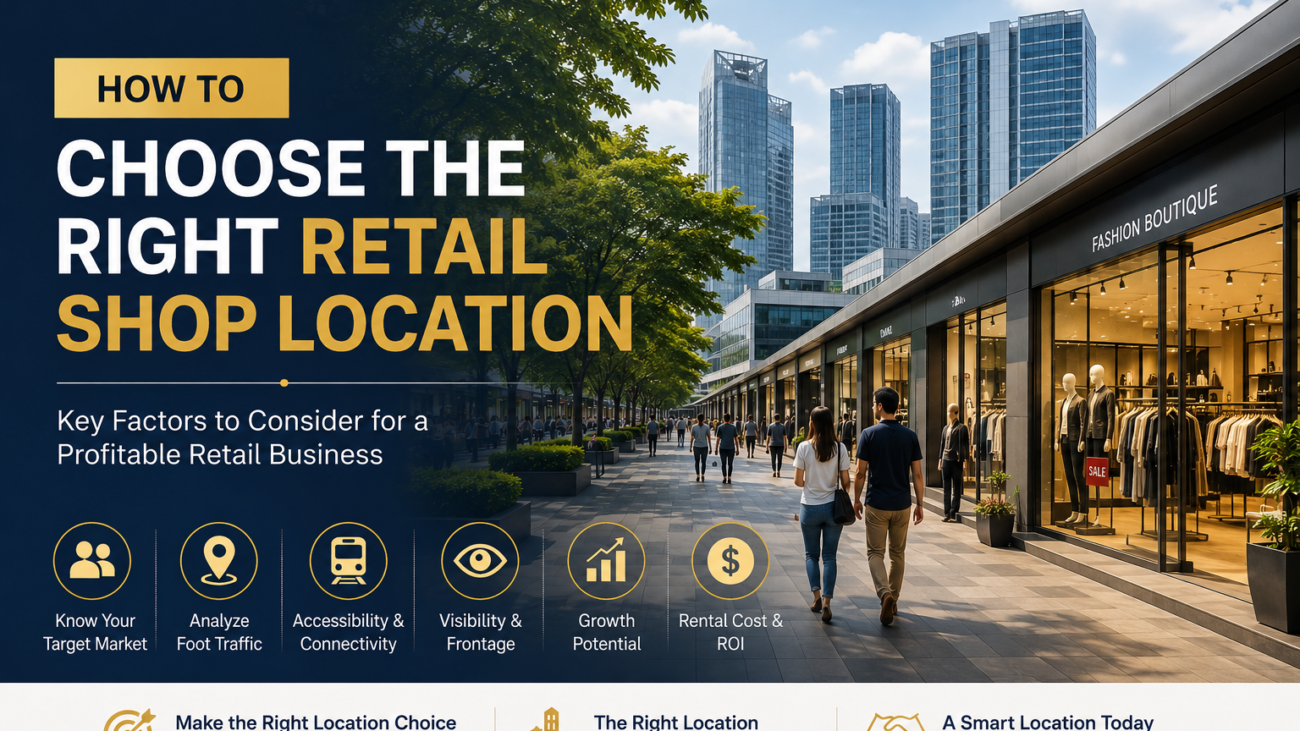
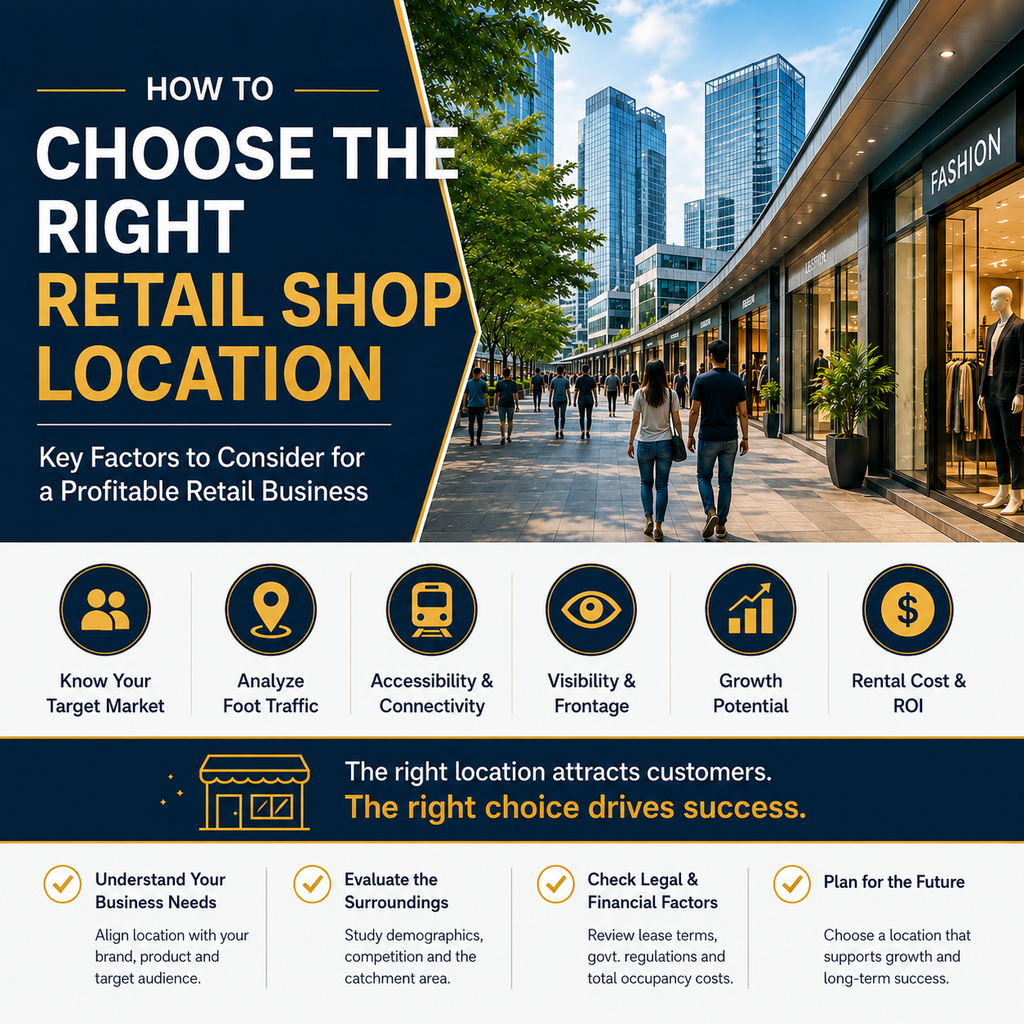
retail shop location in Singapore

How to Choose the Right Retail Shop Location in Singapore

How to Choose the Right Retail Shop Location in Singapore (2026 Guide)

Choosing where to plant your shop is one of the few decisions in retail that you can’t easily undo. You can change your pricing, refresh your signage, or pivot your product range overnight — but a five-year lease on the wrong street corner will quietly drain your business for years. If you’re searching for retail space in Singapore or trying to figure out how to choose a retail shop location, this guide walks through the real factors — footfall, rent benchmarks, taxes, and district-by-district trade-offs — that separate a shop that thrives from one that just survives.

This guide is built for two audiences: entrepreneurs and franchise operators based in Singapore, and Indian investors or retail brands looking at commercial property in Singapore as an entry point into Southeast Asia. Wherever the rules differ for foreign buyers, we’ve flagged it.

Why Location Still Decides Retail Success in 2026

Online shopping hasn’t erased the value of a physical shop — it has raised the bar for what a physical shop needs to do. A location today has to earn its rent through visibility, convenience, and experience, not just proximity to shoppers. Landlords across Singapore have responded by leaning harder into experiential and service-led tenants — beauty, wellness, fitness, F&B, and enrichment brands — while mid-market fashion and low-differentiation retailers face more pressure to justify their space. If your shop can’t articulate why it needs to be seen and visited in person, the wrong location will expose that gap fast.

That’s the lens to bring into every one of the factors below.

Factors to Consider When Choosing a Retail Shop Location

1. Pedestrian Traffic and Footfall Quality

Raw footfall numbers are only half the story — the more useful question is whether the people walking past are your people. A bubble tea kiosk and a bridal boutique can sit on the same street and need completely different traffic patterns: one wants volume and impulse buyers, the other wants intentional, planned visits. Before committing to a unit, spend time physically observing the street at different hours — weekday lunch crowd, evening commute, weekend leisure traffic — rather than relying on a landlord’s footfall claims alone.

2. Population Density and Catchment Profile

A shop’s real catchment is usually a 10–15 minute walk or a short ride, not the whole district. Look at who actually lives and works within that radius: household income, age profile, family size, and whether the area skews residential, office, or transient (tourists, students). Suburban malls in Singapore have benefited precisely because they sit inside dense residential catchments where shoppers no longer feel the need to travel to Orchard Road for everyday retail — a trend that has kept suburban rents climbing steadily even as some central precincts see slower growth.

3. MRT Proximity and Connectivity

MRT proximity remains one of the strongest predictors of sustained footfall in Singapore retail. Units directly linked to or within a two-minute walk of an MRT exit command a premium, but they earn it back through consistent daily traffic that doesn’t depend on weather, events, or seasonality. If your budget can’t stretch to a station-linked unit, the next best option is a location on a direct bus route or a short, safe, well-lit walk from the nearest station — shoppers will forgive a five-minute walk; they won’t forgive a confusing one.

4. Ground-Floor Visibility and Unit Positioning

A ground-floor unit with street frontage will almost always outperform an upper-floor or basement unit for a walk-in retail concept, because it removes the single biggest friction point in retail: getting someone through the door. If a ground-floor unit is out of budget, prioritise clear sightlines from the main entrance or escalator bank instead — a second-floor unit that shoppers see the moment they enter the mall behaves very differently from one tucked around a corner.

5. Competitor and Complementary Tenant Mix

Being near competitors isn’t automatically bad — clusters of similar shops (a “beauty street” or “F&B row”) can pull in shoppers specifically looking to compare and browse. What matters is whether you’re the strongest option in that mix or the weakest. Equally important are complementary tenants nearby: a children’s enrichment centre benefits from being near a supermarket or pediatric clinic; a formal wear shop benefits from proximity to event venues or photography studios.

6. Rental Cost Versus Realistic Revenue Potential

This is where how to calculate retail shop location potential becomes a genuine numbers exercise, not a gut feeling. As of Q1 2026, Cushman & Wakefield recorded prime Orchard retail rents at roughly S$36.50 psf per month, suburban prime rents at around S$33.30 psf per month, and other city-area prime rents near S$21 psf per month — with all three segments still edging upward quarter-on-quarter. Knight Frank’s separate basket put average Orchard gross rent closer to S$31.70 psf per month, underlining that “prime” figures vary by methodology and exact unit.

A simple sanity check before signing: estimate your realistic monthly footfall, apply a conservative conversion rate and average transaction value, and see whether that revenue comfortably covers rent plus a healthy operating margin — not just breaks even. Many first-time retail operators anchor their decision on rent per square foot alone and skip this step entirely.

7. Lease Terms, Renewal Options, and Fit-Out Costs

Beyond headline rent, scrutinise the lease’s escalation clauses, renewal terms, reinstatement obligations, and any restrictions on signage or hours. A slightly cheaper unit with a rigid three-year lease and no renewal option can end up costing more in relocation and fit-out costs than a marginally pricier unit with flexibility built in.

Best Areas to Open a Retail Shop in Singapore

Orchard retail shop Singapore — Singapore’s prime shopping belt commands the highest rents in the country and remains the strongest address for luxury, beauty, and flagship-format brands seeking maximum brand visibility and tourist footfall. Recent leasing activity here has skewed toward established luxury names, which tells you the segment this precinct now rewards best.

Bugis retail shop Singapore — The Bugis and City Hall micro-market has posted some of the strongest rental growth in Singapore over the past year, benefiting from a mix of tourist, office worker, and youth-oriented footfall. It suits fashion, lifestyle, and F&B concepts that want central-area visibility without paying full Orchard rents.

Jurong retail shop Singapore — As a designated regional centre with ongoing residential and commercial growth, Jurong offers suburban rent levels with a genuinely large and growing local catchment. It’s a strong fit for daily-needs retail, F&B, and family-oriented service brands that depend on repeat local visits rather than tourist spend.

East Coast retail space — This corridor combines established residential density with a lifestyle and leisure identity, making it attractive for F&B, fitness, and speciality retail that benefits from a relaxed, community-driven shopper mindset rather than a transactional, mall-hopping one.

The right answer isn’t “which of these is best” — it’s which one matches your product, price point, and target customer’s shopping behaviour.

Regulatory and Financial Considerations for Commercial Property in Singapore

If you’re buying rather than renting, the tax structure for commercial property differs meaningfully from residential property — and understanding this is especially important for retail shop for rent Singapore searchers who may later consider buying, and for foreign investors comparing markets.

  • Buyer’s Stamp Duty (BSD) on commercial property: Commercial and industrial property follows its own progressive schedule — 1% on the first S$180,000, 2% on the next S$180,000, 3% on the next S$640,000, 4% on the next S$500,000, and 5% on the remainder up to S$1 billion. This is a materially different (and in most practical price bands, gentler) schedule than the residential one, which climbs to 6% above S$3 million.
  • Additional Buyer’s Stamp Duty (ABSD): This is the single biggest reason commercial property attracts strong foreign interest — ABSD applies only to residential property in Singapore. A foreign investor buying a retail shop or commercial unit pays the same BSD as a Singapore citizen, with no ABSD layered on top, unlike a residential purchase where a foreign buyer currently faces a steep additional duty.
  • GST on commercial property: Singapore’s GST rate stands at 9% as of 2026, with no change confirmed in Budget 2026. GST applies to the sale and lease of commercial and industrial property — including retail units and shophouses — when the seller or landlord is GST-registered. If you’re GST-registered yourself, this amount is generally recoverable as input tax; if not, it becomes a real additional cost that should be built into your budget upfront.
  • Seller’s Stamp Duty (SSD): Pure commercial retail units are not subject to SSD regardless of holding period — a meaningful advantage over residential property, where SSD can apply for up to four years after purchase.

Regulatory disclaimer: The above figures reflect Singapore stamp duty, GST, and property regulations as verified in August 2026. Tax rates and thresholds are subject to change in future Budget announcements — always confirm current rates with IRAS or a qualified property consultant before transacting.

Renting vs. Buying: A Quick Framework

If you’re testing a concept, expanding cautiously, or watching cash flow closely, a retail unit for rent in Singapore or shophouse for rent in Singapore arrangement keeps capital free and lets you exit or relocate if the location underperforms If you have a proven, established concept and want to lock in occupancy cost against rising rents — or you’re a foreign investor drawn by the absence of ABSD on commercial assets — buying a commercial property for sale Singapore may make more long-term sense. Either path benefits from working with a commercial real estate agent in Singapore who can benchmark the unit against genuine comparable transactions, not just asking rents.

Why Work With a Local Retail Property Specialist

Choosing between a commercial shop in Singapore on a quiet side street and a commercial retail space unit in Singapore inside a high-traffic mall isn’t a decision you should make from listing photos alone. A retail property agent in Singapore who actively works Orchard, Bugis, Jurong, and East Coast deals can tell you which units have genuine footfall versus which ones photograph well but underperform, what a landlord will actually negotiate on rent-free fit-out periods, and which upcoming supply might affect your rent trajectory over the lease term.

As a Singapore retail property specialist, SRG Real Estate works with retail operators and investors — including businesses expanding from India into the Singapore market — to match the right unit to the right concept, not just the right budget. From SRG Real Estate retail properties and SRG Real Estate commercial property listings to end-to-end guidance as your SRG retail property consultant, we help you evaluate footfall, lease terms, and total occupancy cost before you sign anything. Explore current SRG Real Estate shop space listings or speak with our team to shortlist locations that fit your business, not just your budget.

Commercial Property Investment Opportunities in Singapore

Commercial Property Investment Singapore 2026 | SRG Real Estate

Why Commercial Property Investment in Singapore Is Gaining Ground in 2026

Singapore commercial real estate investment has quietly become one of the most compelling asset classes in Southeast Asia. While residential buyers wrestle with a 60% Additional Buyer’s Stamp Duty (ABSD), commercial property investment in Singapore remains structurally exempt from ABSD — a gap that is reshaping where serious capital, including a growing wave of Indian and Malaysian investors, chooses to land.

This guide breaks down the real numbers behind commercial property investment opportunities in Singapore 2026: current office rents, shophouse pricing, rental yields, government duties, and where SRG Real Estate’s commercial division sees the strongest opportunities across the CBD, Marina Bay, and beyond.

Is Commercial Property a Good Investment in Singapore Right Now?

Three factors make the case in 2026:

  1. No ABSD on commercial assets. Unlike residential purchases, commercial and industrial property purchases remain entirely outside ABSD’s scope — meaning a foreign investor pays the same stamp duty as a Singapore Citizen.
  2. Rental yields outperform residential. Shophouses and commercial units are generating gross yields of roughly 4.8%, industrial/logistics assets 4.5–5.5%, and offices around 3–3.5% — all comfortably ahead of the 2–3% typical for residential condos.
  3. Grade A CBD office rents are still climbing. Core CBD Grade A rents reached S$12.50 psf/month in Q2 2026, marking six consecutive quarters of growth, with CBRE Research forecasting roughly 5% year-on-year growth for the full year.

Commercial Property for Sale Singapore: Price Per Square Foot Benchmarks (2026)

SegmentTypical Asking Rent / Price (2026)
Marina Bay / Downtown Grade A officeS$14.00–18.50 psf/month (Marina Bay Financial Centre, Asia Square, IOI Central Boulevard)
Core CBD Grade A office (overall)S$12.50–16.00 psf/month
City-fringe Grade A (e.g. Paya Lebar)S$8.00–10.00 psf/month
Business park spaceS$4.00–6.50 psf/month
Conservation shophouses (D1/D2, D8)S$5,000–8,000+ psf on land area; record deals above S$12,000 psf land
Retail (URA price index)Up 3.3% year-on-year as of Q1 2026

Island-wide office vacancy sits at roughly 10.8%. In comparison, industrial vacancy remains tight at below 5% — a signal that industrial property investment in Singapore continues to be one of the more supply-constrained, income-resilient plays in the market.

Buying Commercial Property in Singapore as a Foreigner

This is where commercial property investment in Singapore for Indian investors and for Malaysian investors becomes genuinely attractive. Under the Residential Property Act, foreigners face no restrictions on buying commercial or industrial property in Singapore — offices, retail shops, shophouses zoned for commercial use, and industrial units can all be purchased with the same access as a local buyer.

Compare that to residential property, where a foreign buyer pays 60% ABSD on top of Buyer’s Stamp Duty. On commercial property, that 60% simply doesn’t apply. For an Indian or Malaysian investor comparing Singapore vs Malaysia commercial property investment, this ABSD exemption — paired with Singapore’s currency stability, rule of law, and transparent URA/IRAS transaction records — is frequently the deciding factor.

Government & Finance: BSD, GST, and IRAS Rules Explained

Understanding the tax stack is essential before you buy office space in Singapore or a shophouse:

  • Buyer’s Stamp Duty (BSD) on commercial property (2026): 1% on the first S$180,000, 2% on the next S$180,000, 3% on the next S$640,000, 4% on the next S$500,000, 5% from S$1.5 million up to S$1 billion, and 6% above S$1 billion — payable by every buyer regardless of nationality.
  • ABSD commercial property Singapore: Commercial and industrial property purchases are exempt from ABSD entirely — this exemption is the single biggest structural advantage over residential investment.
  • GST on commercial property purchase Singapore: Singapore’s GST rate is 9% (effective since January 2024, confirmed unchanged in Budget 2026). GST applies to commercial property transactions where the seller is GST-registered — a cost residential buyers never encounter, since residential sales are GST-exempt.
  • Financing: Commercial property loans aren’t governed by MAS’s residential TDSR framework in the same way, though banks apply their own stress tests. The Loan-to-Value ceiling for a first commercial loan is roughly 55%, versus up to 75% for residential — so budget for at least 45% equity plus BSD, GST, and legal costs upfront.

Always confirm current rates directly with IRAS before transacting, since stamp duty schedules are periodically revised in the annual Budget.

Best Commercial Properties to Invest in Singapore 2026: By Type

Grade A Office Space Investment Singapore. Marina Bay and Raffles Place remain the trophy addresses, with landlords holding pricing power amid tight new supply. Strong choice for investors prioritising capital appreciation and blue-chip tenant covenants.

Shophouse Investment Singapore. Conservation shophouses in Telok Ayer, Club Street, Boat Quay, and Jalan Besar continue to attract family offices and HNWIs as a freehold, supply-capped, wealth-preservation asset — demand has stayed resilient into 2026 even in a higher-rate environment.

Industrial Property Investment Singapore. With vacancy under 5%, B1 industrial and logistics assets offer some of the strongest income-yield stories in the market, particularly in city-fringe locations.

Retail Property Investment Singapore. Retail near MRT stations and high-footfall precincts continues to outperform, while suburban retail near residential catchments benefits from steady necessity-driven demand.

How to Buy Commercial Property in Singapore: A Simple Roadmap

  1. Define your objective — rental yield, capital appreciation, or owner-occupation.
  2. Shortlist asset type and district (Marina Bay office vs. D8 shophouse vs. business park unit carry very different risk-return profiles).
  3. Run the numbers: purchase price, BSD, GST (if applicable), financing at up to 55% LTV, and net rental yield after costs.
  4. Engage a commercial property agent Singapore who understands zoning, tenancy structures, and en bloc risk.
  5. Conduct due diligence via URA and IRAS records before signing the Option to Purchase.
  6. Complete BSD (and GST, if applicable) payment within 14 days of the exercised agreement.

Work With SRG Real Estate’s Commercial Division

Whether you’re a first-time buyer exploring commercial property investment strategy Singapore 2026, or an experienced investor comparing Singapore vs Malaysia commercial property investment, SRG Real Estate’s commercial division and SRG Real Estate commercial consultant team offer end-to-end guidance — from CBD office space investment to shophouse acquisitions — for local, Indian, and Malaysian buyers alike.

As a trusted commercial property agency near me for clients across Singapore, SRG Real Estate combines on-the-ground market data with a transparent, no-pressure investment guide approach. Explore SRG Real Estate’s investment guide or speak to an SRG Real Estate commercial consultant today to review commercial property for sale in Singapore that fits your budget and yield targets.