
industrial property investment Singapore

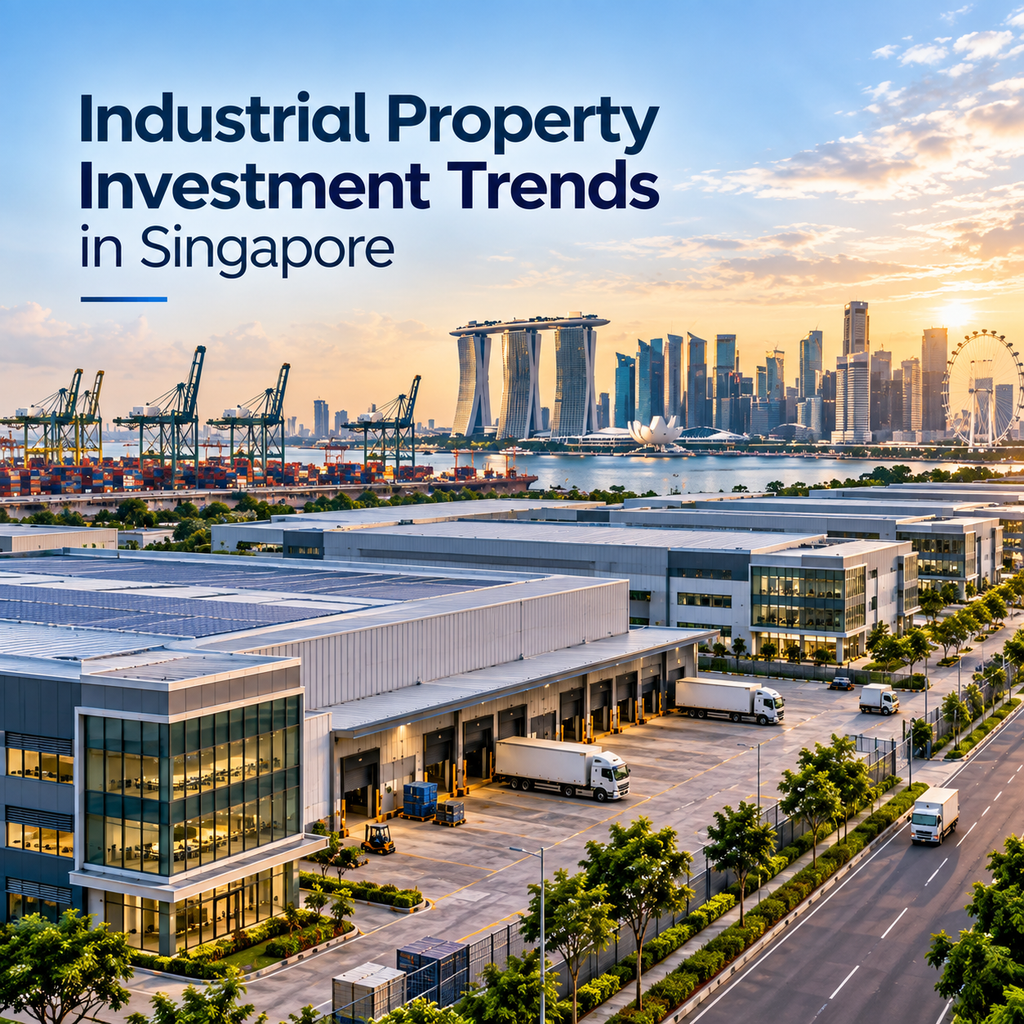
Industrial Property Investment Trends Singapore

Industrial Property Investment Trends in Singapore 2026

Industrial property investment in Singapore has quietly become one of the most resilient asset classes in the country’s real estate market — outperforming both office and retail on a risk-adjusted basis for two straight years. If you’re weighing a B1 industrial property for sale in Singapore, a B2 factory in Tuas, or a warehouse acquisition for logistics income, the data tells a clear story: prices are still climbing, rents are still growing, but the game is getting more selective.

At SRG Real Estate, we track this segment closely because it sits at the intersection of two things Singapore does exceptionally well — manufacturing infrastructure and land scarcity. Here’s what the latest JTC and URA data say about where industrial property Singapore investors should be looking in 2026, and what to watch out for before you sign.

Singapore’s Industrial Property Market at a Glance (2026)

According to JTC’s official statistics, Singapore’s All-Industrial Price Index rose for the eighth consecutive quarter in Q1 2026, up 1.2% quarter-on-quarter and sitting at an all-time high — though the pace has eased from the 1.4% growth logged in Q4 2025. By Q2 2026, industry trackers using JTC data put the price index at 113.8, up 0.6% for the quarter and 3.8% year-on-year.
Rents have been just as durable. The JTC All Industrial Rental Index climbed for its 22nd consecutive quarter in Q1 2026, up 0.4% q-o-q and 2.3% year-on-year — a cumulative gain of roughly 26.5% since the pandemic trough in Q3 2020. CBRE notes this marks eight straight quarters where price growth has outpaced rental growth, a pattern typically driven by investor demand for stable income rather than pure occupier expansion.

Two segments are moving in different directions:

  • Multiple-user factories — the classic strata-titled B1/B2 units most private investors buy — saw prices rise 1.7% q-o-q in Q1 2026, though transaction volume fell nearly 15% as buyers became more price-sensitive.
  • Single-user factories dipped 0.1% q-o-q in price, with transaction counts down over 40%, reflecting a market where large corporate buyers are pausing rather than exiting.

Occupancy has softened slightly at the broad level — island-wide industrial occupancy sits around 89.1%–89.4% — but prime logistics tells a different story entirely. CBRE puts prime logistics occupancy near 95.8% as of Q1 2026, with a path toward 96–97% by year-end, because almost no new prime logistics space is being completed until 2027. If you’re chasing yield with a defensible occupancy floor, this is currently the tightest, most landlord-favorable pocket of the market.

Why the Fundamentals Still Favor Investors

Three structural factors are doing the heavy lifting behind this industrial real estate resilience in Singapore:

1. Genuine land scarcity. JTC manages more than 7,000 hectares of industrial land — about 14% of Singapore’s total land area — and new industrial zoning designations are rare. Unlike residential or even commercial land, the government isn’t creating meaningfully more of this supply category, which structurally supports long-run values.

2. A financing environment that has stayed supportive. CBRE noted the 3-month SORA easing to 1.04% by late April 2026, down from 1.19% at end-2025 — a rate backdrop that has kept holding costs manageable for leveraged industrial buyers even as global uncertainty (including Middle East-linked energy cost risk, per Cushman & Wakefield) clouds the medium-term outlook.

3. No ABSD on industrial property. Unlike residential property, industrial assets carry no Additional Buyer’s Stamp Duty for Singapore citizens, PRs, or foreigners, and Seller’s Stamp Duty restrictions that apply to residential property do not apply here — a meaningful liquidity and tax advantage for investors rotating capital in and out of the segment.

The Supply Wave Coming Through 2027 — What It Means for You

This is the trend line every serious industrial property investment Singapore buyer needs to understand before committing capital.

Colliers projects roughly 1.3 million sqm of new industrial supply arriving by end-2027 — well above the historical annual average. PropNex separately flags a further 1.88 million sqm completing in 2027 alone. Of the supply landing in 2026–2027, Colliers estimates about 28% is warehouse space and 52% is single-user factories, much of which is already pre-committed to specific occupiers rather than being speculatively built.

What this means practically:

  • Prime, well-specified assets will keep outperforming because so much of the incoming supply is pre-leased or purpose-built for a single tenant — it won’t compete directly with strata-titled multi-user stock.
  • Older, lower-specification buildings face real headwinds. Business park vacancy has already risen to around 23.3% as tenants in “Rest of Island” locations gravitate to newer, city-fringe developments — a flight-to-quality pattern that will likely intensify.
  • Warehouse investors have a narrow window. With no new prime logistics completions expected until 2027, existing prime warehouse stock is positioned for further occupancy tightening and rental support through this year.

The takeaway for investors: this is not a market to buy indiscriminately in. Building specification, remaining lease tenure, and tenant profile now matter more than simply being “in industrial.”

B1 vs B2 Industrial Property: What Every Investor Must Get Right

Zoning is the single most common source of costly mistakes in industrial property Singapore transactions, and URA enforcement has been active.

B1 (Business 1) — clean and light industry. Suited to warehousing, e-commerce fulfillment, IT, electronics assembly, product design, and R&D-adjacent activity. B1 zones are typically found in mature estates closer to residential areas — Kallang, Ubi, Kaki Bukit, and Tai Seng are classic B1 clusters, many well-served by MRT.

B2 (Business 2) — general and heavy industry. Covers manufacturing, metalworking, chemical processing, and marine engineering — activities that generate noise, emissions, or heavy vehicle traffic. The National Environment Agency requires a nuisance buffer of up to 100 metres between a B2 zone and surrounding areas, which is why B2 clusters sit in peripheral zones like Jurong, Tuas, and Pioneer, away from population centres.

Both zones fall under URA’s 60/40 rule: at least 60% of a unit’s gross floor area must go to core industrial use, with a maximum of 40% for ancillary purposes like offices, showrooms, or canteens. URA and JTC actively audit for misuse — several operators have faced enforcement action, forced eviction, or six-figure Land Betterment Charges for running offices, gyms, or event spaces out of B1 units without change-of-use approval. Before you buy or lease, always verify the approved use stated in the planning permission — not just the zoning classification on paper.

Rental benchmarks currently sit in the range of roughly S$3.50–5.50 psf/month for B1 space and S$1.20–2.50 psf/month for B2 space, though this varies significantly by building specification, tenure, and precinct.

Where to Look: District-Level Snapshot

Jurong & Tuas (B2-dominant heavy industrial). Singapore’s largest industrial cluster, anchored by Jurong Island’s petrochemical sector and increasingly by the Tuas Mega Port, projected to become the world’s largest single container terminal by capacity when completed in the 2040s. Strata B1/B2 units here transact from roughly S$210–370 psf depending on tenure and building age, with the progressively opening Jurong Region Line (JRL) improving connectivity. Businesses with Malaysia-linked supply chains also benefit from proximity to the Tuas Second Link.

Woodlands (mixed B1/B2, causeway-linked). A logistics-friendly precinct due to its proximity to the Woodlands Causeway, popular with businesses running cross-border operations. Recent transactions span a wide psf range depending on tenure — freehold B2 stock commands a premium over 30-year leasehold equivalents.

Kallang (mature B1 cluster). One of Singapore’s oldest industrial corridors, close to the CBD and well-connected via Lavender and Mattar MRT. Known for food factory clusters and flatted factories, Kallang carries some of the highest B1 psf pricing in the city due to its central location — new freehold B1 launches here have listed well above S$300 psf.

Kaki Bukit / Ubi / Tai Seng (B1 strata heartland). Not in your location list, but worth noting as a benchmark: this is Singapore’s most actively traded B1 strata market, with a deep secondary pool of comparables for valuation purposes.

Industrial Property Financing in Singapore: What Investors Should Know

Unlike residential property, industrial and commercial loans are not subject to MAS’s TDSR or LTV caps — lending terms are set individually by each bank based on borrower risk and asset profile. In practice:

  • Loan-to-Value (LTV): Most banks lend 70–80% of the property’s value or purchase price (whichever is lower), with some extending up to 80–90% depending on the borrower’s financials and the asset’s tenant profile and remaining lease.
  • Loan tenure: Typically 25–30 years, shorter than residential mortgages.
  • Rate structure: Choice of fixed-rate packages or SORA-pegged floating rates, with the 3-month SORA having eased through 2026, supporting serviceability for leveraged buyers.
  • CPF cannot be used for industrial property purchases — financing must come from cash, business funds, or bank loans.

Because industrial credit assessment is more subjective than residential lending, having clean financials, a credible tenancy agreement (for tenanted assets), and a realistic valuation upfront materially improves your negotiating position with lenders.

Is Industrial Property a Good Investment in Singapore Right Now?

For income-focused investors, the case remains reasonably strong: structural land scarcity, no ABSD, favorable financing terms relative to residential property, and multiple consecutive quarters of both price and rental growth. Prime logistics and well-located B1 space in mature estates continue to see the most resilient demand.

The caution is equally real: the 2026–2027 supply wave will separate winners from laggards. Older single-user factories and Rest-of-Island business park space face genuine vacancy risk, while newer, well-specified, well-located assets should continue to command premiums. This is a market that increasingly rewards due diligence over broad-based exposure.

How SRG Real Estate Can Help

Whether you’re evaluating a B1 industrial property for sale in Singapore, comparing a Jurong B2 factory against a Kallang strata unit, or need a second opinion on zoning compliance before you commit, SRG Real Estate’s industrial property consultants can walk you through live listings, financing pathways, and district-level comparables tailored to your investment goals.

📍 Visit us at srgrealestate.sg or find us on Google to speak with an industrial property agent today.
office space for lease Singapore

Office Space Leasing Guide Singapore

Office Space Leasing Guide for SMEs & Startups in Singapore

The office space for lease in the Singapore market is in its sixth straight year of rent growth, and that single fact changes how SMEs and startups should approach leasing in 2026. Singapore’s CBD Grade A office market has entered its sixth year of rent growth, the longest upward cycle on record, with gross effective rents rising to SGD 12.19 per square foot per month in Q2 2026. CBRE data separately puts core CBD Grade A rents at S$12.50 per square foot per month in Q2 2026, the sixth consecutive quarter of growth, with vacancy falling to 5.6%, the lowest in nine quarters.

For an SME or an early-stage startup, that’s not just a statistic — it’s the difference between signing a lease that fits your runway and locking yourself into rent escalations you didn’t budget for. This guide is a practical walk-through of how office leasing actually works in Singapore in 2026: what things cost by district, what the law requires, what to check before you sign, and how to avoid the mistakes that trip up first-time tenants.

Whether you’re relocating a growing team, opening your first Singapore office as a foreign entrepreneur, or shifting from a home office to a registered commercial address, the framework below applies. And if you’d rather skip the research and go straight to viewing shortlisted spaces, that’s exactly what a commercial property agent Singapore businesses trust — like SRG Real Estate — is for.


1. Why Timing Matters More Than Usual in 2026

Three data points define the current market, and all three favor acting decisively rather than waiting for a “better deal” that historically hasn’t materialized:

  • Rents have risen for six consecutive quarters. Grade A CBD office rents rose 2.8% quarter-on-quarter to a record high in Q2 2026, the strongest quarterly growth since 2018, and increased 4.5% year-on-year — the largest annual increase since 2019.
  • Supply is thin and staying thin. Shaw Tower is the only major Grade A completion in 2026, Newport Tower is the sole non-strata development completing in 2027, and the next meaningful wave of supply — from The Sky-waters, The Clifford, One Commerce Centre and Union Square Central — isn’t expected until 2028.
  • Forecasts point in the same direction. Colliers expects 2–4% further growth, Savills projects around 2%, and CBRE has suggested 4–7% growth for CBD buildings through the rest of 2026.

The practical implication: SMEs negotiating renewals or new leases this year have less landlord flexibility than they did in 2022–2023. That makes the difference between an informed tenant and an uninformed one worth real money — which is the entire purpose of this guide.


2. Singapore Office Rental Rates by District (2026)

Office rental in Singapore is quoted per square foot per month ($ psf pm), and the spread between districts is wide enough that location strategy is really a budget strategy in disguise.

CBD Office Space Singapore (Raffles Place, Marina Bay, Shenton Way, Tanjong Pagar): Core CBD Grade A rental rates in 2026 range from roughly SGD 10–16 psf monthly. Raffles Place, Shenton Way and Robinson Road command SGD 12–16 psf for premium buildings, Marina Bay Financial Centre achieves SGD 11–14 psf, and the Tanjong Pagar micro-district — increasingly popular with tech and fin-tech tenants — ranges SGD 9–13 psf. Tanjong Pagar has become the preferred location for technology companies, fin-tech firms and businesses seeking modern building stock at a discount to Raffles Place.

One-North Office Rental (Business Park / Science Park zoning): One-North sits outside the CBD but competes on prestige. Listed asking rents in 2026 for buildings such as Nexus@One-North, Solaris@One-North and Nucleos range roughly S$5.60–S$7.50 psf, while premium options like The Metropolis have been quoted as high as S$8.90 psf — a rate that would get you CBD-adjacent space. Note: One-North is zoned for Business Park use, which restricts occupancy to qualifying industries (R&D, biotech, tech, and related sectors) — confirm eligibility with URA before shortlisting.

Tai Seng Office Rental: Tai Seng has become one of Singapore’s most cost-efficient options for SMEs that don’t need a CBD address. Fitted office and hi-spec industrial-office space in the area is currently listed at roughly S$4.40–S$6.00 psf, with some warehouse-cum-office (B1) space available from S$2.20–S$2.70 psf. This is a common landing spot for logistics-adjacent, e-commerce, and back-office operations relocating out of higher-cost districts.

Orchard Road Office Rental:

 Orchard offers a middle ground — prestige address, non-CBD pricing. Asking rates typically run S$7.50–S$11.00 psf, with some older buildings under S$5.00 psf. However, flexible/coworking desks in Orchard properties like Wisma Atria are also available from operators such as Regus at the lower end of that range.

Quick Comparison Table

DistrictTypical Rate (psf/month)Best Fit For
Raffles Place / Marina Bay (CBD)S$11–16Finance, legal, client-facing HQs
Tanjong PagarS$9–13Tech, fintech, growth-stage startups
Orchard RoadS$7.50–11Retail-adjacent, professional services
One-North (Business Park)S$5.60–8.90R&D, biotech, tech (eligibility required)
Tai SengS$4.40–6Logistics, e-commerce, back-office

Rates are gross asking rents excluding GST and service charges, compiled from current commercial listings and market reports as of Q3 2026. Actual achievable rent depends on floor level, fit-out condition, and lease term negotiated.


3. Coworking & Flexible Office Space Singapore: The SME Alternative

For many SMEs and startups, a traditional lease isn’t the right first move — and Singapore’s flexible workspace sector has matured enough to be a genuine long-term option, not just a stopgap.

Flexible workspace now represent nearly 4% of Singapore’s total office inventory — the highest penetration rate relative to market size in Asia-Pacific. Pricing varies sharply by district: citywide average desk rates have risen to approximately USD 761 per desk per month, with the CBD and Marina Bay at USD 737 and USD 779 respectively, while decentralized areas like One-North (around USD 429) and Tanjong Pagar (approximately USD 595) offer more cost-effective alternatives.

In Singapore dollar terms, hot desks in 2026 start at around S$250/month, with most operators sitting in the S$275–500 band, and even premium operators now offer flexible one-month minimums. Private office suites for small teams typically range from S$500 to S$1,800 per desk per month depending on building grade and district.

When coworking makes more sense than a direct lease:

  • Team size under 20, or headcount that fluctuates quarter to quarter
  • No capital budget for fit-out (coworking includes furniture, internet, meeting rooms, and reception)
  • Need a registered business address without a multi-year commitment
  • Testing the Singapore market before committing to a fixed footprint

For most Singapore SMEs, startups, solopreneurs and regional teams, coworking is usually more cost-efficient than a traditional office lease, while traditional offices tend to make more sense for larger teams with stable headcount and long-term space needs.


4. Understanding Singapore Office Lease Terms

Singapore commercial leases follow fairly standard structures, but the details in each clause materially affect your total occupancy cost.

Typical lease term: 2–3 years for SMEs, with a renewal option; longer terms (5+ years) are more common in Business Parks and larger CBD floor plates, often in exchange for a rent-free fit-out period.

Rental deposit: Standard practice is 3 months’ rent as a security deposit for local companies, sometimes higher (up to 6 months) for foreign-incorporated entities without a Singapore trading history, or for larger fitted-out spaces where landlords want reinstatement cost coverage.

Gross vs. net rent: Most SME leases in Singapore are quoted as gross rent, which bundles in service charge (building management, common-area maintenance, air-conditioning during standard hours). Always confirm what’s included — after-hours air-con, for instance, is frequently billed separately and can be a meaningful monthly line item for teams working late.

Reinstatement clause: Tenants are typically obligated to return the premises to their original (bare or as-handed-over) condition at lease end. This can become an unplanned five- or six-figure cost if you’ve done a substantial fit-out — negotiate this clause before signing, not after.

Rent review: Multi-year leases commonly include a rent review clause (often at each renewal or every 12 months for longer terms). Understand whether reviews are capped, pegged to a market benchmark, or fully open — this affects your long-term cost predictability more than the headline rent does.


5. Government & Finance Rules Every SME Needs to Know

Stamp Duty on Commercial Leases: Stamp duty on a Singapore tenancy agreement is 0.4% of the Average Annual Rent multiplied by the number of years, with leases longer than 4 years capped at the 4-year equivalent — so a 10-year lease pays duty as if it were 4 years, not 10. Under the Stamp Duties Act, the tenant is the default party liable to pay, though parties can contractually agree the landlord absorbs the cost — many commercial leases do exactly that. Stamping must be completed within 14 days of signing (30 days if signed outside Singapore), and late stamping penalties can escalate to 4 times the duty owed. If a sub-lease is involved, note that the sub-lease is independently stampable — the stamp duty paid on the head lease does not cover it.

GST on Commercial Rent: The prevailing GST rate in Singapore is 9% for standard-rated supplies, effective since 1 January 2024, and commercial office rent falls under this standard rate (unlike most residential rent, which is exempt). If your landlord is GST-registered, expect rent quoted as “+ GST” — budget the additional 9% into your occupancy cost calculations from day one, not after your first invoice.

Business Registration & Office Address (ACRA): ACRA requires every Singapore company to nominate a registered office with a physical Singapore address — a PO Box alone is not acceptable. If you’re working from a residential address, check your tenancy agreement and MCST (management corporation) rules first, since strata-titled apartments often prohibit commercial activity or use as a registered business address—a common trap for first-time founders. Foreign entities establishing a local place of business must nominate a Singapore registered office that can accept service of documents and file the appointment via ACRA’s BizFile+ portal. This is one of the most overlooked steps by entrepreneurs establishing a Singapore business — resolve your office address before incorporation, not after.

URA Zoning Considerations: Not every commercial address permits office use as-of-right. Business Park zones (like One-North) restrict occupancy to specific industry categories, and industrial-zoned buildings (B1/B2) have separate rules on the proportion of space that can be used as ancillary office versus operational floor area. Always verify zoning compatibility with URA’s Master Plan or through your commercial property agent before signing — reversing a non-compliant tenancy is far more expensive than checking upfront.


6. How to Lease Office Space in Singapore: Step-by-Step

Step 1 — Define your actual space requirement. Calculate headcount plus realistic growth over your lease term (not your most optimistic hiring forecast). Singapore commercial space is typically planned around 80–150 sq ft per employee depending on layout density.

Step 2 — Set a total occupancy budget, not just a psf target. Rent is the headline number, but GST, service charge, stamp duty, fit-out, and reinstatement provisions all add to true cost. Build all five into your comparison before shortlisting.

Step 3 — Shortlist districts against your actual client-facing needs. If you rarely host client meetings on-site, Tai Seng or One-North pricing can free up capital that a CBD address wouldn’t return in value. If investor and client perception matters daily, the CBD premium may be justified.

Step 4 — Verify zoning and registration compatibility. Confirm the unit’s URA use classification supports your business activity, and that ACRA registered-office requirements are satisfiable at that address.

Step 5 — Negotiate before you fall in love with a unit. Rent-free fit-out periods, capped rent reviews, and reinstatement caps are all negotiable — especially outside prime CBD addresses where landlord competition is real, even in a tightening market.

Step 6 — Get the lease stamped within the legal window. File and pay stamp duty via IRAS e-Stamping within 14 days of signing to keep the agreement legally enforceable.

Step 7 — Work with a commercial property agent who knows current market data. Asking rents and achievable rents are two different numbers, and the gap is usually where a good agent earns their fee.


7. Choosing an Office Space for a Startup in Singapore

Startups face a slightly different calculus than established SMEs — capital efficiency usually outweighs prestige in the early stages. A few startup-specific considerations:

  • Flexible terms beat low headline rent. A slightly higher psf rate with a 6- or 12-month break clause is often better value than a cheaper 3-year lock-in, given how fast early-stage headcount and funding runway can shift.
  • Affordable office space for startups in Singapore is realistically found in coworking (from S$250/month per desk), Tai Seng/city-fringe fitted offices (from roughly S$4.40 psf), or shared serviced-office suites — not in CBD Grade A stock.
  • A registered address matters for fundraising and banking, even before you need real desks. Many startups start with a virtual or coworking registered address, then graduate to a dedicated lease once headcount and revenue justify the fixed cost.
  • Investor and client perception is real but shouldn’t drive the whole decision. A well-fitted One-North or Tanjong Pagar office signals credibility at a lower burn rate than equivalent CBD space.

8. Regulatory Disclaimer

This article is intended for general informational purposes only and does not constitute legal, tax, or financial advice. Rental rates, GST rates, stamp duty calculations, and regulatory requirements referenced above are accurate to the best of our knowledge as of Q3 2026 and are sourced from public market reports (CBRE, JLL, Savills, Knight Frank), IRAS, ACRA, and URA publications. Rates, thresholds, and regulations are subject to change without notice. Readers are strongly advised to verify current figures directly with IRAS (iras.gov.sg), ACRA (acra.gov.sg), and URA (ura.gov.sg), and to consult a licensed corporate secretary, tax advisor, or legal counsel before signing any commercial lease or making incorporation decisions. SRG Real Estate (UEN: S3515756L) accept no liability for decisions made based solely on this content.

Best Districts in Singapore for Property Investment (2026)

Best Districts in Singapore for Property Investment (2026)

Best Districts in Singapore for Property Investment (2026 Guide)

Singapore’s private residential market closed the first quarter of 2026 with its sixth consecutive quarter of price growth — a modest but telling 0.9% quarter-on-quarter gain that signals a market driven by fundamentals rather than speculation. For anyone researching Singapore property investment, that stability is exactly the point. This isn’t a market built for quick flips; it’s built for investors who understand which district matches which goal — capital preservation, rental income, or long-term appreciation.

This guide breaks down the best districts in Singapore for property investment, compares them on price, yield, and growth potential, and explains the buying rules that matter most if you’re investing from India or anywhere outside Singapore.

Understanding Singapore’s District Framework: CCR, RCR, and OCR

Before ranking districts, it helps to understand how Singapore’s Urban Redevelopment Authority (URA) segments the private housing market into three regions:

  • Core Central Region (CCR) — Districts 9, 10, 11, plus parts of 1, 2, 4, 6, 7, the Downtown Core, and Sentosa. Singapore’s prime addresses: Orchard, River Valley, Holland Village, Bukit Timah, Newton, Novena.
  • Rest of Central Region (RCR) — City-fringe districts including 3, 5, 7, 8, 12, 13, 14, 15, 19, 20, and 21. Covers areas like East Coast, Queenstown, Toa Payoh, and Paya Lebar.
  • Outside Central Region (OCR) — Singapore’s suburban heartlands, Districts 17–19 and 22–28, including Tampines, Punggol, Woodlands, and Jurong.

Each region behaves differently in terms of price growth, rental yield, and buyer profile — which is the entire basis for choosing the right district for your investment goal.

The 2026 Singapore Property Market Snapshot

A few figures set the context for anyone comparing Singapore property market performance across regions this year:

  • Private home prices rose 3.4% for the full year 2025 — the slowest pace since 2020 — while new-launch sales volume jumped roughly 67% year-on-year, reflecting steadier absorption rather than overheating.
  • In Q1 2026, non-landed private residential prices rose 1.3% quarter-on-quarter, with the OCR leading at +2.2%, RCR at +0.8%, and the CCR at +0.6% after rebounding from a 3.5% decline the previous quarter.
  • The island-wide rental index rose 0.3% quarter-on-quarter, a recovery from a Q4 2025 dip, with non-landed rents outperforming landed.
  • Analysts are projecting full-year 2026 private price growth in the 2–5% range — moderate, fundamentals-driven, and consistent with a maturing rather than overheated cycle.

The headline takeaway for property investment in Singapore 2026: the OCR is currently leading on price momentum and yield, the RCR remains the analytical sweet spot balancing rent-ability and upside, and the CCR has stabilized into a capital-preservation play rather than a high-growth one.

District 9 (Orchard, River Valley, Cairn hill): The Prestige Core

District 9 anchors Singapore’s most recognizable address — Orchard Road — alongside River Valley and Cairn hill. It is the benchmark for District 9 Singapore property searches, and for good reason: no other district carries the same brand recognition with international buyers.

  • Pricing: Entry-level studios and 1-bedroom units typically start around S$1.4M–S$1.8M (400–650 sqft), reflecting roughly S$2,600–3,000 psf. Broader CCR non-landed pricing spans S$2,200–5,500 psf, with trophy addresses exceeding S$7,000 psf.
  • Rental yield: Roughly 3.0% gross — modestly ahead of District 10, reflecting strong tenant demand from expatriates and high-net-worth professionals.
  • Best suited for: Buyers prioritizing liquidity, prestige, and long-term capital preservation over cash yield. District 9 resale stock also benefits from consistently strong resale liquidity relative to newer, less-established CCR pockets.

District 10 (Holland Village, Bukit Timah, Tanglin): Capital Growth With Lifestyle Premium

District 10 has posted some of the strongest price momentum in the CCR — driven by rare freehold stock around Orchard’s fringes and the enduring appeal of Bukit Timah’s landed enclaves and international schools. It’s the district most frequently searched under District 10 Singapore property.

  • Pricing: New developments post-2020 typically start at S$1.5M–S$2.2M for a 1-bedroom, with 2-bedroom units (750–950 sqft) starting around S$2.5M–S$3.5M. Freehold units carry a 10–20% premium over comparable 99-year leasehold stock.
  • Rental yield: Around 2.6% gross — the lowest of the three prime districts, but offset by superior capital appreciation; select projects near the start of Orchard Road have seen two-year price gains above 40%, largely in larger, rarer units.
  • Best suited for: Long-horizon investors chasing capital appreciation over income, particularly those interested in freehold stock or landed property (subject to Residential Property Act approval for foreign buyers).

District 11 (Novena, Newton): The Value Entry Point to the Prime Core

District 11 offers the most accessible entry into the CCR, trading at a meaningful discount to Districts 9 and 10 while still carrying the postal-code prestige of the Core Central Region — a common question for anyone comparing District 11 Singapore property against its prime-district neighbours.

  • Pricing: Typically 8–15% lower in psf terms than comparable D9/D10 stock, largely because Novena and Newton lack the Orchard Road or Bukit Timah brand premium, and building quality is more varied.
  • Rental yield: Comparable to broader CCR averages (roughly 2.5–3.0% gross), supported by proximity to Novena’s medical hub (Tan Tock Seng, Mount Elizabeth Novena) and strong MRT connectivity via the North-South and Downtown lines.
  • Best suited for: Investors who want CCR exposure — and the long-term scarcity value that comes with it — without paying the full Orchard or Bukit Timah premium.

Beyond the CCR: Where the Yields Actually Are

If your priority is rental income rather than prestige, the data increasingly points away from Districts 9, 10, and 11. This is worth stating plainly, because it’s one of the more counter-intuitive but well-supported findings in the current Singapore real estate market:

RegionDistrictsGross Rental Yield (2026)Character
CCR (Prime)9, 10, 112.5% – 3.0%Capital preservation, prestige, top resale liquidity
RCR (City-fringe)3, 5, 8, 14, 15, 19, 203.0% – 4.0%Balanced yield and appreciation — the “sweet spot”
OCR (Suburban)18, 19, 22, 253.5% – 5.0%Highest cash yield, strongest recent price momentum

District 15 (East Coast, Marine Parade) stands out within the RCR for its sticky expat rental demand tied to international schools, with yields around 3.8–4.2%. Within the OCR, Jurong East, Tampines, and Woodlands are consistently cited as the highest-yielding sub markets in Singapore, at 4.0–5.0% gross, driven by strong Db-upgrader and middle-management tenant demand paired with lower entry prices. The RCR has also delivered the strongest five-year cumulative returns of any region — roughly 47% since 2020 — making it a genuine contender for investors who want both property appreciation and rental yield rather than choosing one over the other.

Which District Fits Your Investment Goal?

  • Want prestige, liquidity, and a long-term store of value? District 9 or District 10.
  • Want CCR exposure at a lower entry cost? District 11.
  • Want the best balance of yield and growth? District 15, District 19, or other RCR addresses.
  • Want maximum gross rental yield? OCR sub markets like Jurong East, Tampines, or Woodlands.

There is no single “best” district — only the best district for your specific horizon, risk tolerance, and whether you’re optimizing for rental yield or capital appreciation.

Rules and Taxes: What Foreign Investors (Including Indian Buyers) Need to Know

Singapore’s property investment rules are unusually transparent, but the tax structure materially changes the maths for non-resident buyers — a critical point for Singapore property buying rules and Singapore property taxes research.

  • Buyer’s Stamp Duty (BSD): Applies to every buyer regardless of nationality, on a progressive scale up to 6% of the purchase price or market value, whichever is higher.
  • Additional Buyer’s Stamp Duty (ABSD): This is the figure that reshapes every foreign buyer’s calculation. Foreigners currently pay a flat 60% ABSD on any residential purchase — first property or fifteenth, with no owner-occupier exemption. These rates have held since April 2023, with no changes announced in Budget 2026.
  • FTA exceptions: Nationals of the United States, Iceland, Liechtenstein, Norway, and Switzerland are taxed at Singapore Citizen rates under bilateral free trade agreements. India does not currently hold this exemption, so Indian buyers are subject to the standard 60% foreign-buyer ABSD rate.
  • Residential Property Act (Cap. 274): Foreigners can buy strata-titled condominiums and apartments without prior approval. Landed property, vacant residential land, and certain heritage shophouses require Singapore Land Authority approval, which is granted only in exceptional cases.
  • Commercial alternative: ABSD applies only to residential property. Commercial and industrial assets are exempt from ABSD, which is why many Indian investors expanding into Singapore evaluate commercial or industrial property alongside residential options as part of a broader entry strategy.

Given the 60% ABSD load, foreign residential purchases in Singapore work best as long-term, fundamentals-driven holds rather than short-cycle plays — reinforcing why district selection and rental yield matter more, not less, for overseas investors.

Why Work With a Local Property Consultant

District-level nuance — freehold versus leasehold premiums, which micro-locations within a district are outperforming, and how ABSD interacts with your specific buyer profile — is where a Singapore property consultant earns their fee. SRG Real Estate has advised both Singapore-based investors and Indian buyers evaluating Singapore property, with a working knowledge of current URA data, IRAS stamp duty treatment, and district-by-district rental demand. If you’re comparing a District 9 Singapore property against a District 15 or Jurong East alternative, that’s exactly the conversation worth having before you commit capital.