

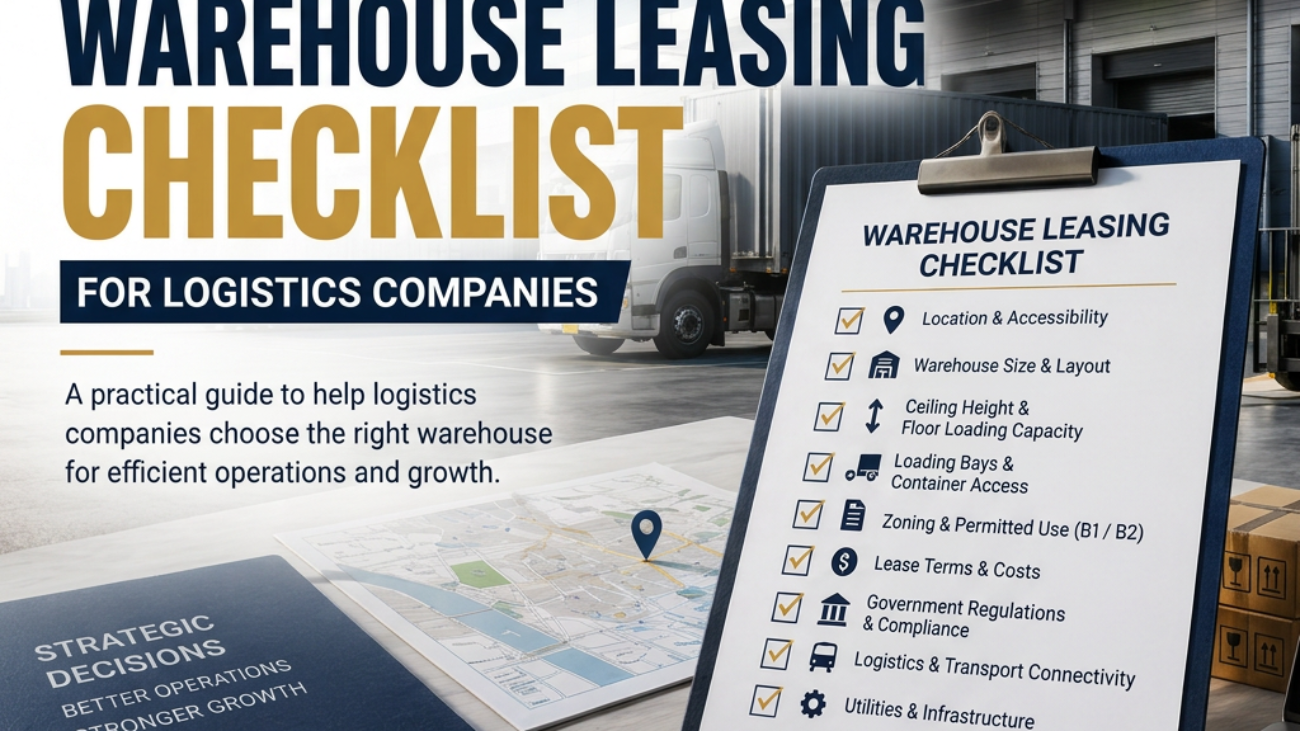
Warehouse Leasing Checklist for Logistics Companies: What to Verify Before You Sign in Singapore
If you’re scaling a logistics operation in or into Singapore, the warehouse you choose will quietly determine your margins for the next three to six years. A cheap headline rent on a unit with no ramp access, a weak floor load rating, or a 45-minute detour from PSA or Changi Airfreight Centre can cost more in wasted trips than the rent itself. This is the warehouse leasing checklist we walk logistics clients through at SRG Real Estate before any offer to lease is signed — built for teams operating between India and Singapore, where cross-border 3PLs, freight forwarders, and distribution businesses are actively hunting for reliable B2 industrial space.
Singapore’s industrial market has now posted rental growth for over five years running. The JTC All Industrial Rental Index climbed 0.4% quarter-on-quarter in Q1 2026, and warehouse-specific rents rose again in Q2 2026, with overall industrial occupancy at 89.1%. Translation: good warehouse stock near the ports, PIE, and AYE is not sitting idle, and logistics tenants who move without a checklist tend to overpay or under-spec.
Quick Answer: The 12-Point Warehouse Leasing Checklist
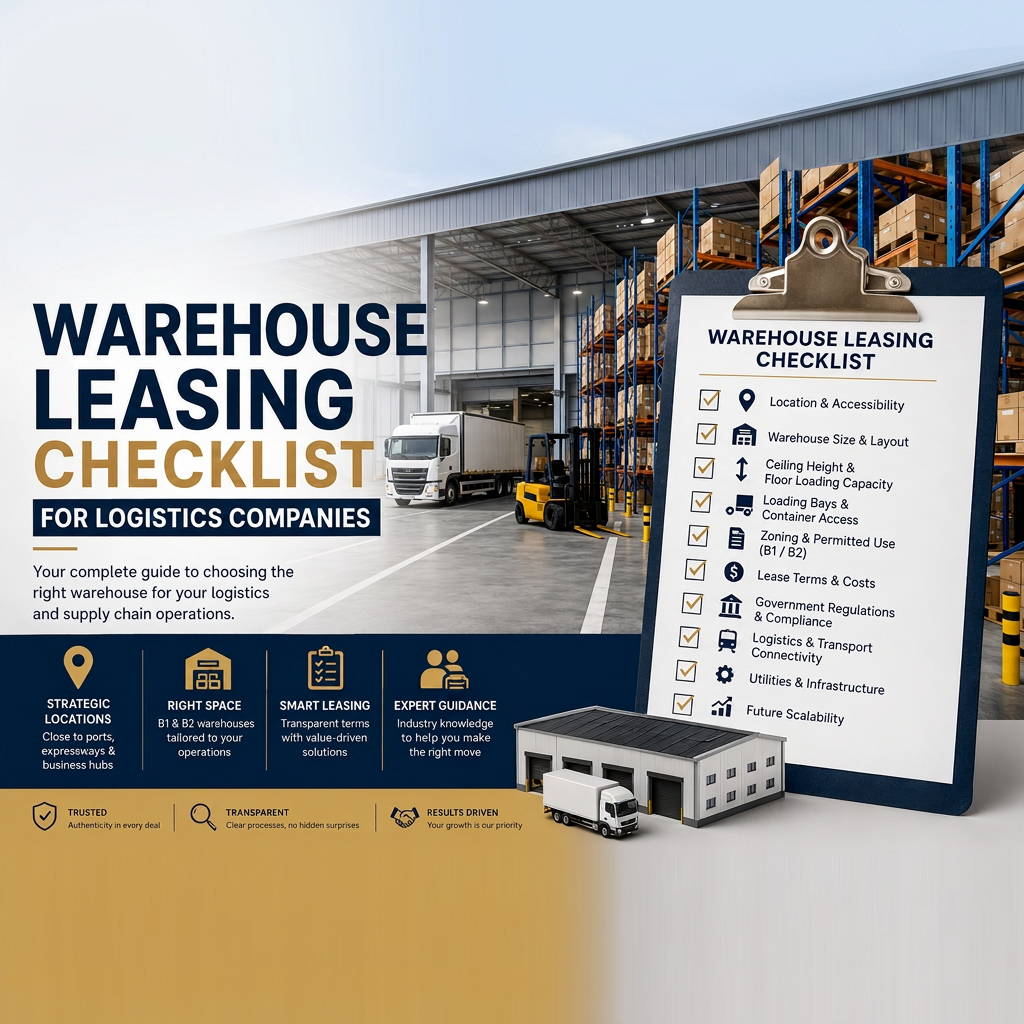
- Zoning — B1 (light industrial) vs B2 (general industrial) suitability for your cargo
- Loading bay count, dock height, and truck turning radius
- Ceiling height and floor loading (kN/m²) for your racking system
- Proximity to ports (PSA Tuas, Jurong Port) and Changi Airfreight Centre
- Proximity to MRT for warehouse staff and last-mile riders
- JTC land lease vs private strata vs master-lease sub-tenancy
- Lease tenure, renewal option, and rent escalation clause
- All-in occupancy cost: rent + property tax + service charge + GST
- Fire safety, sprinkler (FM200/wet system), and SCDF compliance
- Racking system compatibility and floor flatness (FM2 standard)
- Power load (3-phase capacity) for cold chain or automation
- Sub-letting, assignment, and expansion/downsizing flexibility
Each item below explains why it matters and what actually to check — not just what to ask.
1. Confirm Zoning: B1 vs B2 Industrial Property Singapore
Before anything else, confirm whether the unit is zoned B1 (light industrial) or B2 (general industrial). A B2 industrial warehouse Singapore listing permits heavier, noisier, or higher-intensity logistics use — palletised storage, cross-docking, light assembly — while B1 space restricts certain activities and machinery. Freight forwarders and 3PLs handling general cargo almost always need B2 zoning; B1 units may look cheaper but can force you into a URA change-of-use application later, which costs time and sometimes isn’t approved at all.
2. Loading Bay, Dock Height, and Truck Access
This is the single most underrated line item on any warehouse rental checklist Singapore logistics operators use. Check:
- Number of loading bays relative to your daily truck volume
- Dock leveller height (standard container trucks vs smaller vans)
- Turning radius for 40-ft trailers if you handle containerised freight
- Whether the loading bay is covered (matters during Singapore’s rainy months)
A warehouse with excellent square footage but a single loading bay will bottleneck your operation the moment volumes scale.
3. Ceiling Height, Floor Load, and Racking System Compatibility
Your racking system determines your storage density, and your racking system depends entirely on ceiling clear height and floor load capacity (measured in kN/m²). Ramp-up B2 warehouses typically offer 6–12m clear height suited to selective or narrow-aisle racking; ground-floor conventional warehouses may cap out lower. Ask for the structural floor load rating in writing — not a verbal estimate — especially if you’re running high-bay racking or mezzanine storage.
4. Proximity to Ports and Air Cargo Hubs
For logistics warehouse Singapore searches specifically, location relative to PSA’s Tuas mega-port, Jurong Port, and Changi Airfreight Centre should shape your shortlist before price does. Every extra 10km of drayage between port and warehouse adds recurring trucking cost that compounds over a 3-year lease. This is why Tuas, Gul Circle, and the western industrial corridor remain the default first search for import/export-heavy logistics tenants.
5. Proximity to MRT
Warehouse operations still run on people — pickers, forklift operators, admin staff, last-mile riders. Space within 10–15 minutes of an MRT station has a measurably easier time hiring and retaining warehouse staff than sites reachable only by shuttle bus. Worth trading a small rent premium for, particularly outside peak logistics zones.
6. Understand Your Lease Structure: JTC vs Private Landlord
Two very different paths exist for a JTC warehouse lease in Singapore:
- Direct JTC lease — you lease land or ready-built facilities straight from JTC Corporation, Singapore’s industrial landlord. JTC revised its rental rates for the second half of 2026, effective 1 July 2026, so always confirm you’re quoted the current rate card, not an outdated one.
- Private landlord / master-lease sub-tenancy — most listed “warehouse for rent Singapore” units are actually private strata-titled space or sub-leased from a master tenant. These offer more flexible tenure (1–3 years vs JTC’s longer commitments), but rents are market-driven and can move faster with demand cycles.
Neither path is universally “better” — it depends on whether you need long-term security (JTC) or short-to-mid-term flexibility (private).
7. Lease Tenure, Renewal Terms, and Escalation Clauses
Standard private industrial leases in Singapore run 2–3 years with a renewal option; JTC land leases run far longer (often 30+30 years for land, shorter for ready-built facilities). Before signing, get clarity on:
- Rent-free fitting-out period (typically 1–2 months)
- Annual escalation percentage, if any
- Renewal option terms and whether rent reverts to “prevailing market rate”
- Reinstatement obligations at lease end (this can be a real cost — get a quote upfront)
8. Calculate the True All-In Occupancy Cost
The quoted psf rent is never the full number. Budget for:
- Base rent — Singapore industrial/warehouse psf asking rates currently range roughly from S1.00toS3.50 per sq ft per month depending on location, specification, and building age, with high-spec ramp-up B2 space and cold-chain facilities sitting at the upper end.
- Property tax on industrial property Singapore — non-owner-occupied industrial property is taxed at a flat 10% of Annual Value, payable to IRAS. If you’re subletting or your landlord passes this through, factor it into your effective occupancy cost.
- Commercial lease stamp duty Singapore — tenancy stamp duty is charged at 0.4% of the total rent for leases of four years or less (or 0.4% of four times the average annual rent for longer leases), payable to IRAS before the lease is finalised.
- GST on industrial property Singapore — GST at the prevailing standard rate of 9% applies to rent and service charges where the landlord is GST-registered.
- Service charge — covers common area maintenance, security, and shared facilities; varies significantly by building.
Add these four together, and the “real” psf cost is often 15–25% higher than the headline asking rent.
9. Fire Safety and SCDF Compliance
Logistics warehouses storing flammable goods, F&B, or pharma stock need to confirm the unit’s fire safety classification matches your cargo type. Ask for the Fire Safety Certificate status, sprinkler system type, and whether SCDF approval is required for your specific storage use before you commit — retrofitting a sprinkler system after signing is expensive and slow.
10. Power Load and Utilities
Cold-chain, automated racking, and EV-charging fleets all draw significant power. Confirm the unit’s 3-phase electrical capacity in writing, not verbally, especially if you’re inheriting a fit-out from a previous tenant whose usage profile was different from yours.
11. Sub-Letting, Assignment, and Flexibility Clauses
Logistics demand is seasonal and contract-driven. Before signing, check whether the lease permits sub-letting or assignment if your space needs shrink mid-term, and whether the landlord offers a right of first refusal on adjacent units if you need to expand. This single clause has saved several of our clients from breaking a lease early.
12. Total Cost vs Total Fit: Don’t Optimise for Rent Alone
The lowest psf option is rarely the lowest total-cost option once drayage distance, staff turnover, and reinstatement costs are factored in. Run the full checklist above against two or three shortlisted units before deciding — not just the cheapest one.
Where to Look: Warehouse for Lease by Location
Warehouse for lease Tuas — Singapore’s primary western logistics and port-adjacent corridor, now anchoring PSA’s Tuas mega-port operations. Best fit for import/export-heavy 3PLs and freight forwarders who need short drayage distances and B2 zoning at scale.
Warehouse for lease Woodlands — Northern corridor with strong connectivity toward the Woodlands Checkpoint, useful for logistics companies running cross-border freight into Malaysia alongside domestic Singapore distribution.
Warehouse for lease Senoko — Established industrial estate in the north with a mix of B1 and B2 stock, popular with mid-sized logistics and light manufacturing tenants seeking value relative to central locations.
Warehouse for lease Gul Circle — Deep in the Jurong/Tuas industrial belt, close to Jurong Port and Gul Circle MRT — a strong shortlist candidate for heavy B2 general industrial and bulk storage warehouse requirements in Singapore.
Supply and Rent Trends Logistics Tenants Should Watch in 2026
A few data points worth knowing before you negotiate:
- Industrial and warehouse rents have now risen for over 20 consecutive quarters. However, the pace of increase has been easing through 2026 — useful leverage when negotiating renewal terms rather than assuming rents will keep climbing at the same rate.
- JTC expects roughly 400,000 sq m of new industrial space to be completed in the second half of 2026, with close to half of that being warehouse space — meaning more B2 warehouse-for-lease Singapore options should surface through late 2026 and into 2027, particularly benefiting tenants who can wait for new completions rather than needing space immediately.
- High-specification, ramp-up, and cold-chain facilities remain the tightest segment even as aggregate supply grows, because suitability depends on ramp access, loading provision, and building spec — not just floor area.
If your lease renewal or search window has flexibility, timing your move around these completions can meaningfully improve your negotiating position.
Work With a Warehouse Property Agent Who Knows the Checklist
At SRG Real Estate, warehouse leasing Singapore searches are one of our most common briefs from logistics companies expanding between India and Singapore. As an SRG industrial property agent, we run every shortlisted unit through this exact checklist before it reaches a client — zoning, loading bay capacity, all-in cost, and lease flexibility — so you’re not discovering a floor-load problem after signing.
Whether you’re comparing B2 industrial warehouse Singapore options in Tuas, evaluating a JTC warehouse lease, or need a fast market read on warehouse space for logistics company use near the ports, our team can shortlist units and negotiate terms on your behalf.
Get in touch with SRG Real Estate for warehouse leasing support in Singapore: 🌐 srgrealestate.sg ⭐ View our Google reviews 🏢 UEN: S3515756L