

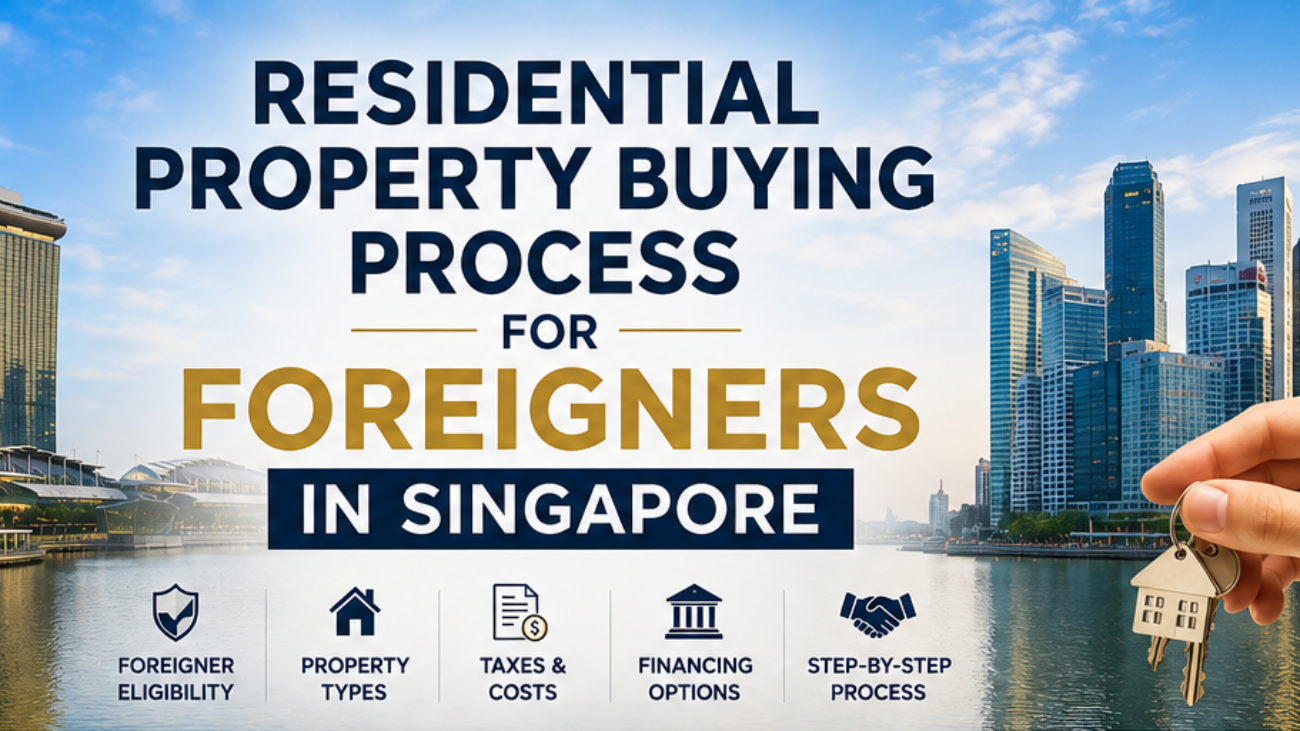
If you’ve been searching for “residential property buying process for foreigners in Singapore,” the short answer is yes. More foreigners are doing it yearly, attracted by Singapore’s stability, strong currency, and world-class infrastructure.
This guide outlines the residential property buying process for foreigners in Singapore. It covers what you can buy, how much it costs, and how the transaction unfolds.
It will also help you avoid surprises three weeks into a deal.
We work with buyers from India, the Gulf, China, and beyond monthly at SRG Real Estate. The questions are almost always the same: What am I allowed to own? What will I actually pay in stamp duty? Can I get a loan? Here’s the complete residential property buying process for foreigners in Singapore, based on the current 2026 rules.
What Can Foreigners Actually Buy?
Confusion often begins here.
Singapore’s Residential Property Act splits housing into two broad buckets.
Which bucket a property falls into determines whether you need government approval to buy it.
Freely purchasable, no approval needed:
- Private condominiums and apartments (any district, any developer)
- Strata-titled landed houses inside approved condo developments
- Executive Condominiums (ECs) once they pass their 10-year Minimum Occupation Period and are fully privatized
Restricted, requires Land Dealings Approval Unit (LDAU) clearance:
- Landed homes — bungalows, semi-detached houses, terrace houses, Good Class Bungalows — anywhere outside Sentosa Cove
- Vacant residential land
Completely off-limits to non-citizens and non-PRs:
- HDB flats (new or resale)
Sentosa Cove is the one well-known exception where foreigners can buy a landed home without the usual LDAU hurdle. Owner-occupation conditions apply. For the vast majority of overseas buyers, the practical answer is simple. The residential property buying process for foreigners in Singapore often centers on buying a condo. Over 95% of foreign residential transactions in Singapore fall into the private condominium and apartment category. It has zero approval friction, so you can walk into a purchase the same week you find the right unit.
The Real Cost: ABSD, BSD, and What They Mean for You
Buyers in Singapore pay Buyer’s Stamp Duty (BSD), a progressive tax.
It runs from 1% on the first S$180,000 up to 6% on amounts above S$3 million.
For a S$2 million condo, BSD is about S$69,600, payable within 14 days of exercising your Option to Purchase.
Then comes the number that changes the entire equation for overseas buyers: Additional Buyer’s Stamp Duty for foreigners in Singapore currently sits at a flat 60%, applied to any residential purchase regardless of whether it’s your first property or your fifth. This rate has held since April 2023, and Budget 2026 didn’t touch it. On a S$1.8 million Marina Bay condo, that’s roughly S$1.08 million in ABSD alone, on top of BSD.
There’s one notable carve-out: nationals of the United States, Iceland, Liechtenstein, Norway, and Switzerland are treated the same as Singapore Citizens for ABSD purposes under their countries’ Free Trade Agreements with Singapore, meaning 0% on a first property. Everyone else — including Indian, Malaysian, Chinese, and Gulf nationals — pays the full 60% rate. If you’re weighing Singapore against other Southeast Asian markets, this is the single biggest cost variable to model before you fall in love with a floor plan.
Can Foreigners Get a Property Loan in Singapore?
Yes. Singapore banks — DBS, OCBC, and UOB, and several foreign banks — do lend to non-residents. The terms are tighter than what locals get.
- Loan-to-Value (LTV): up to 75% on a first private residential property, provided the loan tenure stays within 30 years and ends before you turn 65
- Total Debt Servicing Ratio (TDSR): all monthly debt commitments, including the new mortgage, can’t exceed 55% of gross monthly income, stress-tested at roughly 4%
- CPF: off the table — non-PR foreigners fund everything in cash
- Documentation: passport, employment pass or equivalent, 3–6 months of payslips, tax assessments, and often a Singapore-based relationship manager
Getting an In-Principle Approval (IPA) from a bank before you start viewing units is worth the extra few days — it tells you your real budget and makes your offer more credible when you do put in an Option to Purchase.
The Step-by-Step Buying Process
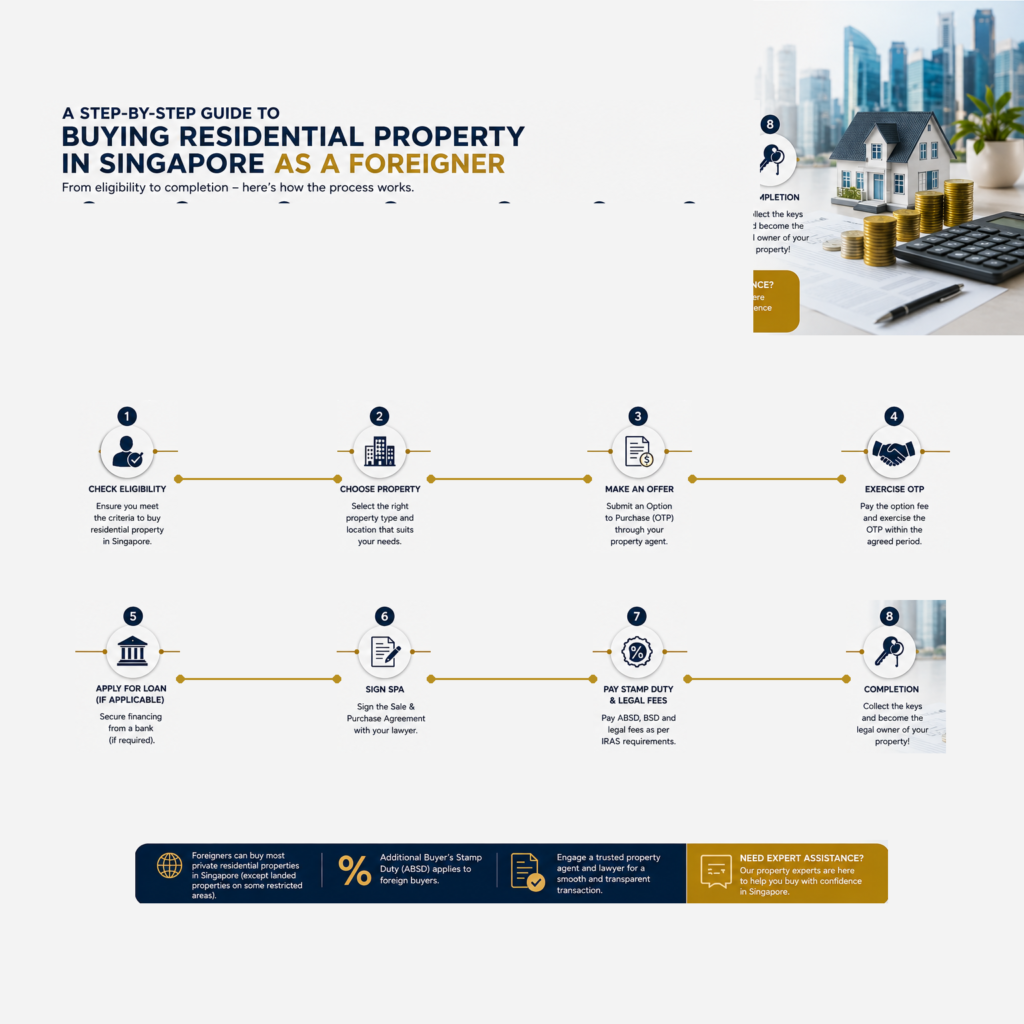
- Get pre-approved. Secure In-Principle Approval from a bank so you know your borrowing limit before you shop.
- Search and shortlist. Work with a licensed property agent in Singapore who understands foreign-buyer eligibility — this rules out restricted landed stock immediately and saves you weeks.
- View and negotiate. Once you find the unit, agree on price and terms with the seller or developer.
- Sign the Option to Purchase (OTP). You pay an option fee (commonly 1% of the price) for an exclusive window — typically 14 days for resale — to decide.
- Exercise the OTP. Pay a further deposit (bringing the total to around 5%), which converts the option into a binding contract.
- Pay stamp duties. Your conveyancing lawyer e-stamps the transaction with IRAS and settles BSD and ABSD, due within 14 days of exercise.
- Finalize your mortgage. The bank arranges valuation and prepares the loan for disbursement.
- Complete the purchase. For a resale unit, completion typically lands 8–12 weeks after exercising the OTP; new launches under progressive payment run on a longer schedule tied to construction stages.
- Collect your keys. Your solicitor registers the transfer with the Singapore Land Registry, and the property is officially yours.
Where Foreign Buyers Are Looking
In Singapore, foreign demand concentrates in prime districts such as District 9, 10, and 11.
These areas include Orchard, Holland, Bukit Timah, and Novena.
Moreover, it is increasingly directed at Marina Bay and the Downtown Core.
Additionally, new-launch condos and waterfront apartments offer lifestyle appeal and rental depth.
When weighing a new launch against a resale unit, remember that new launches feature fresh fittings and progressive payment terms.
Resale provides a faster path to keys and a track record of actual rental yields to study.