

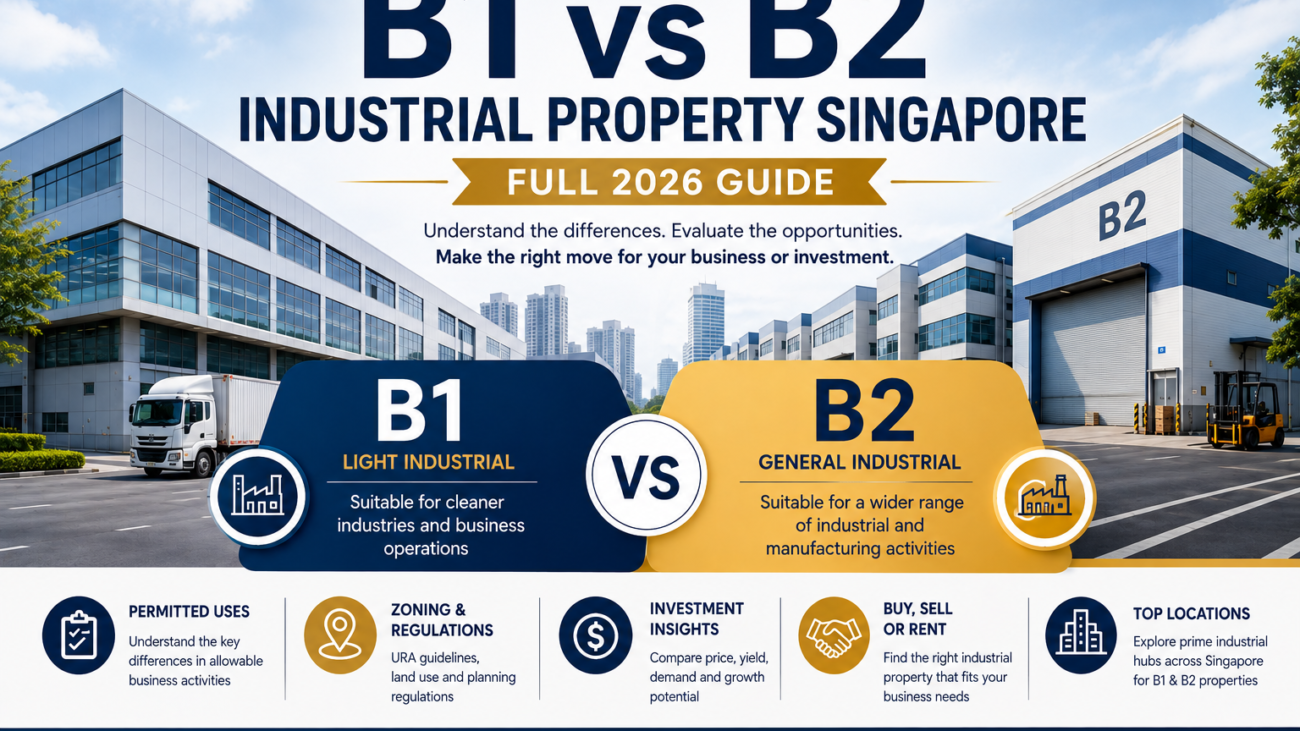
Understanding B1 vs B2 Industrial Properties in Singapore
Additionally, if you’re looking at factories rather than homes, you will notice B1 vs B2 industrial properties in Singapore on listings.
However, explanations usually come late, after you make multiple viewings regarding B1 vs B2 industrial properties in Singapore.
Additionally, this gap in B1 vs B2 industrial properties in Singapore is what this guide is meant to close.
Whether you’re a manufacturer outgrowing your unit, an investor comparing yield across asset classes, or an Indian entrepreneur or NRI.
The B1 vs B2 industrial properties Singapore distinction isn’t a technicality.
Additionally, B1 vs B2 industrial properties Singapore determine what you’re allowed inside the four walls you pay for.
Get it wrong, and you could face a URA enforcement notice.
Moreover, a forced relocation, or a rejected Change of Use, could follow in B1 vs B2 industrial properties in Singapore.
At SRG Real Estate, this is one of the questions we field often from both local SMEs and overseas investors.
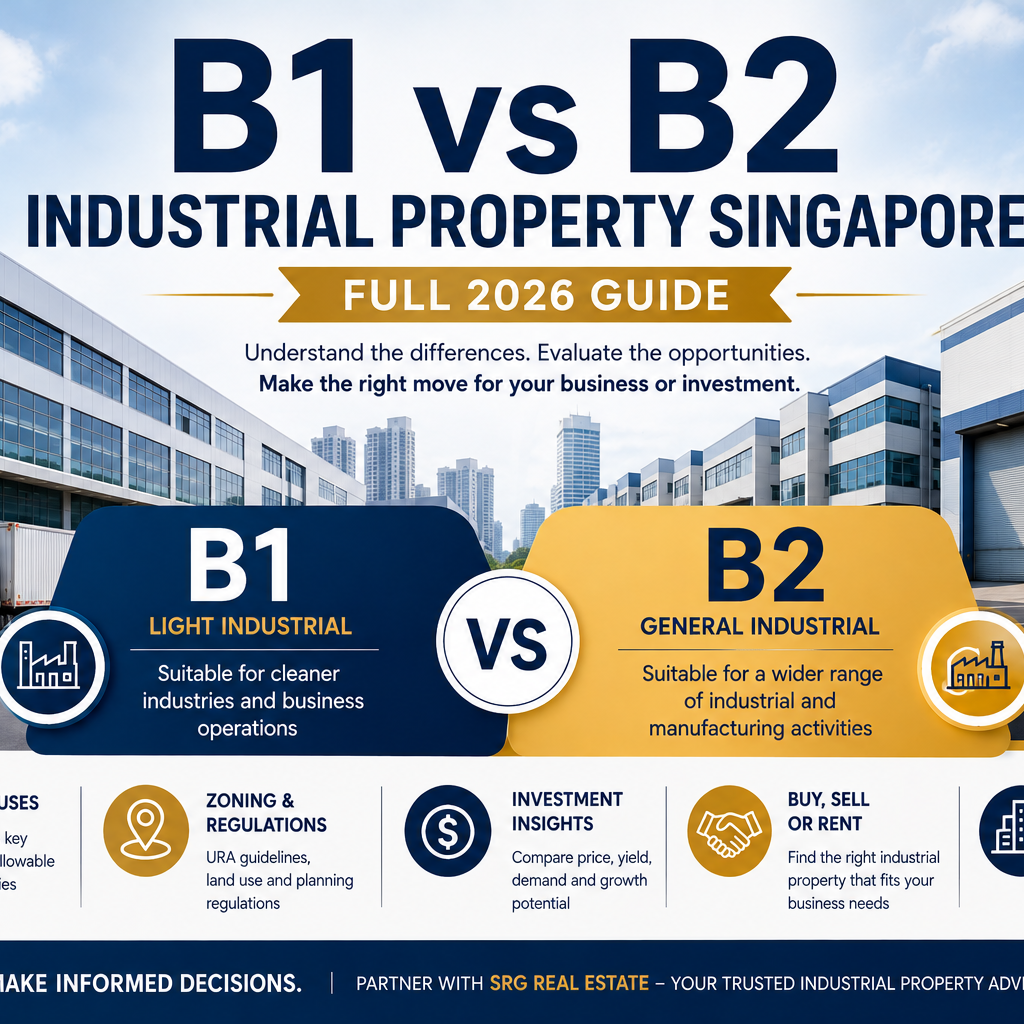
What Is B1 Industrial Property in Singapore?
B1 is short for “Business 1” — a URA Master Plan zoning classification reserved for clean, light, and non-pollutive industrial activity. Think electronics assembly, software and R&D operations, precision engineering, media production, packaging, and light warehousing. None of these generates the noise, smoke, odour, or vibration that would bother a neighbour, which is precisely why B1 industrial space in Singapore is allowed to sit close to residential and commercial districts
However, B1 vs B2 industrial properties in Singapore illustrate how zoning choices can shape nearby development and ensure compatibility. As a result, these uses are designed to minimise emissions and disruption to nearby areas, aligning with urban planning goals. Consequently, B1 space remains suitable for locations near residential and commercial districts.
The National Environment Agency backs this up with a 50-metre nuisance buffer requirement between a B1 development and its surroundings — a much lighter restriction than what applies to heavier industry. That’s also why B1 buildings have started looking less like factories and more like offices. Many newer B1 factory developments in Singapore feature glass facades, lift lobbies, and business-park-style common areas, even though the internal floor loading and power specs are still built for genuine industrial use.
A useful way to think about B1: if your business could plausibly operate in a building where people also live within a few hundred meters, it’s probably a B1 fit.
What Is B2 Industrial Property in Singapore?
B2, or “Business 2,” is the zoning for general and heavy industrial use
In Singapore, B1 vs B2 industrial properties illustrate contrasting use profiles.
This covers heavier manufacturing, vehicle servicing and workshops, and chemical or biotech processing.
Additionally, B1 vs B2 industrial properties in Singapore it includes operations involving significant noise. It also involves emissions or heavy vehicle traffic.
B2 industrial estates are deliberately kept away from residential areas, concentrated instead in estates like Jurong, Tuas, Woodlands, Senoko, Kranji, and Buroh.
B2 space typically comes with larger floor plates, higher floor loading, and more generous loading-bay and heavy-vehicle access — the physical infrastructure heavier operations actually need. Rents per square foot tend to run lower than B1, partly because B2 estates sit further from MRT lines and residential catchments, and partly because the tenant pool is more specialised.
B1 vs B2 Industrial Property Singapore: Key Differences at a Glance
| Factor | B1 (Light Industrial) | B2 (General/Heavy Industrial) |
| Permitted use | Clean, light industry — electronics, R&D, packaging, light warehousing | Heavier manufacturing, workshops, chemical/biotech, logistics |
| Environmental impact | Minimal — no significant noise, smoke, odour | Higher — noise, emissions, heavy traffic possible |
| Nuisance buffer | 50m NEA buffer from residential areas | Larger buffer; deliberately segregated from housing |
| Typical estates | Ubi, Kaki Bukit, Tai Seng, Kallang | Jurong, Tuas, Woodlands, Senoko, Kranji |
| MRT access | Generally good | Variable, often car/truck-dependent |
| Rental rate | Higher psf | Lower psf |
| Tenant profile | Tech, R&D, media, precision engineering, showrooms | Manufacturing, logistics, vehicle servicing, process industries |
| Capital appreciation (5-yr trend) | Stronger in MRT-linked estates | More moderate, higher entry-to-exit spread |
Neither zone is inherently “better” — the right one depends entirely on what your business does or what tenant profile you’re underwriting as an investor.
The URA 60:40 Rule Explained.
Regardless of whether you’re in a B1 or B2 building, URA’s industrial property zoning framework applies a 60:40 usage rule to nearly every unit. At least 60% of the gross floor area must go toward the approved core industrial activity — manufacturing, warehousing, R&D, or whatever the anchor use is. The remaining 40% can be ancillary space: offices, a showroom, a staff canteen, meeting rooms.
This is one of the most common compliance traps for both new tenants and unfamiliar investors. Fit out too much of the unit as office space, and you’re technically in breach — which can trigger enforcement action or the need for a Change of Use application, along with the fees and delays that come with it. If you’re buying B1 or B2 industrial property for sale in Singapore with a specific tenant already lined up, it’s worth checking their intended floor plan against the 60:40 ratio before the deal is signed, not after.
JTC vs Private Industrial Property: What Buyers Need to Know
A large share of Singapore’s industrial land is leased out by JTC Corporation, the government’s master industrial landlord, typically on 20- to 30-year terms (with some private-developer leasehold stock running to 60 years). JTC-leased units carry conditions that private strata industrial property doesn’t:
- Assignment approval — selling or subletting a JTC unit generally needs JTC’s sign-off, and the incoming buyer must qualify as a genuine industrialist with an approved use, not a passive investor.
- Occupation requirements — many JTC allocations require the buyer to actually operate a qualifying business from the unit for a minimum period, screening out pure yield-chasers.
- Since September 2017, resale of strata industrial units acquired from a developer is restricted to end-users only for the first three years, a rule the Ministry of Trade and Industry introduced specifically to curb speculative flipping.
By contrast, private strata industrial developments — more common in estates like Ubi, Kaki Bukit, Tai Seng, and Paya Lebar — can usually be bought by individual investors without demonstrating an active industrial business, financed through standard commercial loans, and sublet freely. If your primary goal is rental yield rather than owner-occupation, private strata B1 or B2 stock is usually the more accessible route.
In 2026, JTC also widened its lease renewal framework: eligible tenants can now engage JTC up to 10 years before lease expiry (up from 6), and a Flexible Lease Extension Initiative lets qualifying 20-year lessees extend by up to two 5-year tranches. Worth factoring in if you’re evaluating a JTC-leased asset with a shorter remaining tenure.
Where to Find B1 and B2 Industrial Property: Central Singapore & Key Estates
Location-wise, B1 industrial property in Central Singapore clusters around Ubi, Kaki Bukit, Kallang, and Tai Seng — mature estates well served by the MRT and close enough to town to appeal to tech, media, and design tenants who still want an industrial rent instead of a CBD office rent. B2 industrial property in Central Singapore is far rarer, since heavier industry has historically been pushed to the west and north — Jurong Industrial Estate, Tuas, and Woodlands remain the core B2 clusters.
This geographic split matters for anyone comparing industrial property in Singapore as an investment: B1 units in inner, MRT-linked estates have shown stronger five-year capital appreciation, driven by land scarcity and the gradual upgrading of older industrial stock. B2 assets in the outer west have generally delivered higher gross rental yields at a lower entry price, appealing to investors underwriting cash flow over capital growth.
Can B1 Industrial Property Be Used for Manufacturing in Singapore?.
Yes — but only for manufacturing that falls within the “clean and light” definition. Additionally, in B1 vs B2 industrial properties in Singapore, electronics assembly and precision engineering are common in B1 buildings. What B1 does not permit is any process generating significant noise, smoke, odour, or vibration. Welding-heavy fabrication, large-scale chemical processing, or anything requiring heavy machinery with a large footprint typically needs a B2-zoned unit. If you’re unsure which side of the line your process falls on, obtain confirmation from URA before you commit. Therefore, this helps avoid NEA complaints later.
B1 vs B2 Industrial Property for Investment: Which Offers Better Returns?
There’s no universal answer — it comes down to what you’re optimising for.
- B1 in MRT-accessible estates tends to command a premium purchase price but attracts a broader, higher-quality tenant pool (tech firms, R&D outfits, corporates wanting an “office-like” industrial address), which supports both occupancy and capital appreciation over time.
- B2 in outer estates typically offers a lower entry price and a higher headline rental yield, but the tenant base is more specialised and more exposed to manufacturing-sector cycles.
Industrial property in Singapore tends to outyield residential. Moreover, gross yields are in the mid-single digits, higher than private residential. Additionally, unlike residential property, industrial property carries no ABSD for any buyer. This holds for citizens, PRs, and foreigners. For B1 vs B2 industrial properties in Singapore, this difference draws Indian investors and NRIs. No ABSD wall and no Residential Property Act restrictions. Investors gain full eligibility to purchase strata industrial or commercial units without special approval.
Buying or Renting B1/B2 Industrial Property: Costs, Stamp Duty & Foreign Investor Eligibility
A few finance and government-facing details worth knowing before you transact:
- Buyer’s Stamp Duty (BSD) applies to industrial property purchases, same as any other property type, but ABSD does not — a meaningful cost saving compared to residential.
- GST may apply if the seller is GST-registered, calculated on the purchase price — a cost that catches first-time commercial and industrial buyers off guard.
- Seller’s Stamp Duty (SSD) restrictions can apply within the first three years for certain strata industrial resales bought from a developer, even though industrial property is otherwise SSD-light compared to residential.
- Financing for industrial property typically comes with a lower loan-to-value ratio than residential, so plan for more equity upfront.
- Foreign eligibility: foreigners, including Indian nationals and NRIs, face no additional restrictions on buying industrial property in Singapore beyond the same JTC assignment/occupation conditions that apply to any buyer of JTC-leased stock. Private strata B1/B2 units are generally the more straightforward entry point for a foreign investor who isn’t planning to operate the business personally.
None of this is tax or legal advice — always verify current BSD/GST rates and JTC eligibility conditions with IRAS, JTC, and your own lawyer or tax advisor before transacting, since these figures are revised periodically.
Working With an Industrial Property Agent in Singapore
Because B1 and B2 zoning, the 60:40 rule, and JTC assignment conditions all interact with each other, most buyers and tenants don’t shop for industrial property the way they’d shop for a condo. A specialist industrial property agent or industrial real estate consultant in Singapore will typically flag zoning fit, check the intended-use compliance before you fall in love with a unit, and — for JTC-leased stock — help pre-screen eligibility before you waste time on an application that was never going to be approved.
At SRG Real Estate, our industrial desk works across both B1 and B2 stock island-wide, including Central Singapore’s B1-heavy estates and the western B2 clusters, for local businesses, investors, and overseas buyers — including a growing number of Indian and NRI clients evaluating Singapore industrial property as part of a broader Southeast Asia allocation.
The Bottom Line
B1 and B2 aren’t just zoning codes — they define who your neighbours can be, what your business is legally allowed to do inside the unit, how the space will be priced, and who’s likely to want it back from you when you sell. Getting the classification right before you sign anything saves you from a URA enforcement letter down the line, and getting the investment case right — B1’s appreciation story versus B2’s yield story — depends on what you’re actually trying to build.
If you’re comparing B1 vs B2 industrial property for your own operations or as an investment, SRG Real Estate’s industrial team can walk you through current listings, JTC eligibility, and zoning fit across Singapore’s industrial estates. Reach out for a no-obligation consultation.